Tampilkan postingan dengan label Economists. Tampilkan semua postingan

Kamis, 28 Desember 2017

Economists as Public Intellectuals

I ran across a video by my former Chicago Booth colleague Austan Goolsbee that prompts some reflection on the role of economists as public intellectuals. (In addition to my gentle scolding of Greg Mankiw in the last post.)

Austan:
"Hi, I'm an actual economist (MIT PhD degree shown) 
and I promise you 
Donald Trump's tax plan is a scam. ... 
This tax cut was designed to help Johnny Marshmallow (Billionaire, with monopoly man image) ... 
President Trump believes that if you give more money to big corporations and billionaires that money will trickle down to you..."
Let us analyze the rhetoric of these amazing sentences carefully. 
"I'm an actual economist (MIT PhD degree shown)" 
This is an argument by authority, by credentialism. He, Austan, has a PhD from a Big Name institution. What follows is therefore a result of that special knowledge, that special insight, that special training, that actual economists have. He doesn't have to offer logic or fact, which you won't understand, and you aren't allowed to argue back with logic or fact, unless perhaps you too have a Big Name PhD.  What follows isn't just going to be Austan's personal opinions, it inherits the aura of the whole discipline. By implication, anyone who disagrees isn't an "actual economist."
"Donald Trump's tax plan is a scam"
This are the most interesting 7 words.


It is not, in fact, "Donald Trump's" tax plan. It is, clearly, a tax plan hashed out by Republicans in Congress, with some input from the administration, mostly the Treasury department. Almost nothing in this comes form Donald Trump. Just how many nights was President Trump up late on his laptop sweating over the income and depreciation limits of pass-through income deductions? Not many, I'd wager. So why is Austan calling it "Donald Trump's tax plan," not (say) "Congressional Republican's tax plan?"

Once you ask, I think it's obvious. President Trump is a reviled figure in the audience that Austan is aiming his video at. So personalizing it, wrapping policy up in Trump's personality, loading the actions of our complex political system into the actions of one person, though it manifestly is nothing of the sort, serves an obvious rhetorical purpose. Hate Trump, hate the plan. It is the first of many dog-whistles.  

"Scam" is the single most interesting word.
"scam." noun. informal 
1. a dishonest scheme; a fraud. "an insurance scam." 
synonyms: fraud, swindle, fraudulent scheme, racket, trick; pharming; informalcon, hustle, flimflam, bunco, grift, gyp, shakedown. "the scam involved a series of bogus investment deals"
(-Google dictionary) 
Now, detecting "scams" is not the sort of thing that Real Economists are trained to do. We can analyze incentive effects and distribution tables, spot budget constraints, and argue over deficits and economic growth effects.  But "scam" is an accusation that the intentions of those writing the tax bill are malign. Just how does Herr  Prof. Dr. Austan Goolsbee, "real economist," know anything at all about the intentions behind the tax bill? To say nothing of (now that he personalized it) Donald Trump's intentions?

But I am giving Austan too much credit to treat this as an interesting or original rhetorical device. You've heard "tax scam" before, I presume. "#GOPtaxscam" was right there on a big billboard in front of Nancy Pelosi as she denounced the bill. It's already a hashtag Her official website starts with
“Today, President Trump signed into a law a GOP tax scam...
A quick google search reveals a whole website devoted to "GOP tax scam," and its many echoes in the political media.

(I would be curious to find the source and history of the phrase. But I'm not patient enough at google searching to do it.)

So this is not clever Austan rhetoric. Austan is repeating a well-orchestrated bit of democratic party spin, talking point, or propaganda. It's the second dog-whistle.

Political parties do this. They search for some phrase that catches the ear.  They aim primarily to marshal moral outrage and demonize the political opposition.  Hence "scam" not "distorted incentives" or "misplaced priorties" [growth vs. redistribution]. The phrases are fairly meaningless. But if you repeat them over and over again, they start to get meaning and energize the base.

Really, Austan? Is this the best you can do? Is the role of public intellectuals and "real economists" to assert their intellectual superiority by their credentials, and then to repeat whatever buzzword their chosen political party is pushing these days, be it "tax cuts for the rich" "make america great again" or ,"tax scam?"

"Tax scam" is particularly loathsome for an honest intellectual as it is useful as partisan rhetoric.  It does not appeal to any actual analysis of the tax code, or the troublesome fact that Obama himself wanted to cut corporate taxes, and ran a few dollars of deficit along the way. Instead it just attacks the motivations of the other side. And then people like Austan complain of partisanship.
"This tax cut was designed to help Johnny Marshmallow" (Billionaire, with monopoly man image)"
This is a flat out ... untruth. I'm trying to be polite. Perhaps Austan's analysis of the general equilibrium burden of taxation reveals that in the end Johnny Marshmallow gets a better deal out of it than Joe Working Stiff. But it is simply untrue that the tax cut was designed to that purpose.  The clear design was to lower the cost of capital, thereby increase investment, and thereby raise productivity and wages. This is the clear public statements of the designers. We can argue whether it will work as designed. But if you're going to attack motivations you have to deal with the constantly repeated statements of the designers, and the absence of any evidence for the contrary view. "Real Economists" have no special training in journalistic or historical analysis, for assembling evidence on intentions. And it shows.
"President Trump believes that if you give more money to big corporations and billionaires that money will trickle down to you..."
Again, here is a statement of a fact, by a PhD academic, with not a whiff of evidence. Just where in the MIT PhD program do they train you to make statements of fact with no evidence? How does Austan know what President Trump "believes?"

"Trickle down" is another dog-whistle calumny, another bit of rhetorical propaganda, another deliberate placing of evil words in an opponent's mouth, another big lie (let's be frank about it) that Austan and company hope that by passing around over and over again will become truth.

I would be very interested to see any quote from anyone who worked on this tax bill advocating that it will work by "trickle down." The argument for it is that it works by incentives. A better prospective rate of return gives companies a better reason to invest. Period. "Trickle down" is a pejorative version of Keynesian economics, not of incentive economics. It was invented by critics of tax reform.

Austan has plenty of company. Larry Summers, usually excellent at offering actual economic analysis in defense of democratic party causes, seems to have lost his bearings. After eight years of very influential commentary that the economy is in "secular stagnation" and requires massive deficit financed government spending, after complaining that the roughly $10 trillion added to the national debt during the Obama years was inadequate, Larry now proclaims in a Washington Post oped that the economy is on a "sugar high," and that the prospective $1.5 trillion in additional debt over the next 10 years
will also mean higher deficits and capital costs, it will likely crowd out as much private investment as it stimulates.
His "10,000 people will die!" attracted a lot of attention

Perhaps something about Trump's style causes people to become unhinged. But it does not escape notice when economic analysis changes sharply the minute after an election, and I think Larry lost a lot of his reputation for economics-based analysis. 

Alan Blinder, in an amazingly weak attack on the tax bill in the WSJ did a better job. Why do I say weak? Tot up Alan's arguments: 1) Republican senators and representatives overdid their back-slapping and Trump-congratulation at the signing ceremony. 2) Trump was wrong to claim it's the biggest cut in history. Reagan and Bush were bigger. 3) The new tax bill, like the old one, is full of special provisions and deductions. 4) The personal tax cuts expire, to fill budget rules, unless congress extends them. 5) it raises the deficit 6) The process wasn't open enough 7) a revenue neutral, distribution-neutral, broaden the base, cut the rates reform like 1986 -- and like the one Paul Ryan started out with before it went through the congressional sausage machine -- would have been better.

Alan repeated the "trickle down" calumny, and like Larry his concern about the deficit is a bit of a sudden conversion. But other than that,  he makes a good honest effort with a weak hand. I agree with 3 and 7, and don't think it's my job to comment on 1, 2, 4, and 6. But that it could have been better seems a weak argument for throw it all out.

**********

This all builds up to some positive thoughts. What is a good role for policy-engaged economists, or even economists who want to transcend institutional boundaries and become public intellectuals? What are some useful rules to follow?

Usually, "actual economics" finds little of value in either political party's propaganda. Echoing that propaganda is a sure sign of empty analysis, so avoid it.

Actual policy is usually a very messy political compromise of any clear economic vision. Peggy Noonan had, I think, the right attitude in last Saturday's Wall Street Journal:
The fair way to judge the tax bill was never through the mindless, whacked-out rhetoric on both sides—the worst bill in the history of the world, the best thing since Coolidge was a pup—but through the answer to one question: Will this bill make things a little better or a little worse?...
"mindless whacked-out rhetoric" is spot on -- and a spot on characterization of what Austan offered in place of actual economics. A little better or a little worse is a good frame for analyzing any policy proposal.

Actual economics is most delightful because it offers answers outside of the usual morality play.  Focus on incentives, not who gets what out of the tax code.  Point out the missing budget constraint. Notice that the behavior you deplore is a rational response to a misguided incentive, not a sign of evil.

Politics thrives on demonization. But it is a fact, which people who have tasted Washington like Summers and Goolsbee have done should know better than the rest of us, that the vast majority of people in public life are good people, and have the same goals. Democrats and Republicans, even many from the outer fringes of the parties, fundamentally want a better life for all Americans, and prioritize those in tough circumstances more than others. They disagree, and deeply, about cause and effect mechanisms to reach that common goal. It is not good politics to point this out, nor good for advancing one's particular solution to a problem through the political process. But it is much better policy analysis, and much better scholarship to acknowledge the truth.

Don't play politician. You're trained to be an economist, not a politician. Ed Lazear tells a good story of once offering political advice to President Bush, and being quickly shut down. Bush told him to give the best possible economic analysis and leave the politics to Bush.

Now, one can make some room for economists actually working in the government. A treasury secretary must, once the internal give and take is over, sell the imperfect product. But that can mostly be done with creative silence, and does not extend to parroting propaganda. Economists who used to work in government, and presumably wish to return also must to some extent show they are part of the team. But articulate, analytical and a bit one-sided support need not dip to propaganda and demonization. And our political system could do with a little more self-restraint, politeness, abstention from calumnies and demonization too.

Obviously, bending over backwards to point out deficiencies on both sides of the partisan divide, and good things on the other side, when one can, is useful to establish some credibility.

Doing otherwise also further tarnishes the brand name of economics, and academia, and science in general. When Austan wraps his political dog-whistles in "I'm an Actual Economist" and shows his PhD, honest citizens don't so much update the deep truth of democratic party propaganda, they update on what academic credentials mean, and what academic research and analysis is. No, 99% of us are not here to scream one party's talking points are the utter truth, and the others scheming evildoers.

It does more than tarnish some vague reputation of "actual economists" (I may be kidding myself that we have much!) Austan's employer is a non-partisan, non-profit, explicitly forbidden to engage in  political activity as a condition of receiving tax-deductible gifts, to operate as a non-profit, and to receive federal funds. The reputation if not the tax status of academia is in question. Universities are widely perceived, and not altogether incorrectly, as hotbeds of partisan political activism.  Congress is waking up, and the tax bill also started to rein in our privileges.

While faculty are entitled to our opinions, and to express them, and to engage as private citizens in political activity, and to speak as we wish, when we drag our professions in, the response is natural.  If Austan had merely started "Hi, I'm an actual ex-Democratic administration official, hopeful to get a new and better job in the next Democratic presidency, and ..." I would have little objection at all.

Ad-hominem attacks, attacks on an an intellectual opponent's motivation, especially with no documented evidence at all for that attack, used to be strictly out of bounds for "actual economists," and scholars in general.

In fact, productive discussion is usually enhanced when one ignores motivations that are there and documentable. It's better to win on logic and fact and ignore motivation. Contrariwise, when you see an argument by motivation, which Austan made three times in as many sentences, you should infer that the arguer has neither fact nor logic to offer.

That agreement not to impugn motives is the only hope for a productive conversation, either in academia or in politics. Once you say "scam," that's over.

Update:

Austan responds with class:


In person, Austan has always been an exemplary person to debate public policy with. He supports his arguments with logic and fact, and displays a deep command of the economics literature. "Now wait a minute there John, there was this study in the QJE last year that showed...." and I would have to humbly say "Hmm, I'll have to read that." Unlike many other economists, he never shot back easy talking points, party propaganda, or arguments by motives.  In part, I guess, the contrast between the private and public Austan got me so grumpy in this post. I don't bother to criticize Paul Krugman or Brad DeLong for far worse sins.


Read more

Mankiw on endowment taxes

Greg Mankiw wrote a New York Times column December 24 criticizing the university endowment tax. I disagree, not so much with the wisdom of the tax, but with the wisdom of writing such an article.

The tax is small -- 1.4% of endowment income. So if $100 of endowment earns 10%, or $10 of income, the university pays 14 cents. Still, with $38 billion of endowment like Harvard's, or $22 billion like Stanford's that adds up to some real money.

Greg writes that it is "hard to justify this policy." Universities invest in "human capital, which means educating our labor force" and "the knowledge that flows from basic research." Mainly, though, Greg's against the tax because the few elite universities with more than $500,000 endowment per student, (unlike the community colleges and state schools that actually do train the labor force)
"use their resources [to offer] need-blind, full-need admissions...."
"At Princeton [$24 billion] about 60 percent of undergraduates get financial aid. This aid covers the entire cost of tuition, room and board for students from families with income below $65,000 a year."
In sum, Greg feels that universities provide a public good, of refraining from charging tuition for low-income students, so should retain this subsidy. And subsidy it is. While I think all capital taxes should be zero for everyone, given that everyone else pays capital taxes, the fact that universities can borrow at tax-free rates, accept tax-exempt gifts, put the money into endowments which are run like funds-of-funds, hiring high-priced managers to send money to high-priced managers of hedge funds, private equity, venture capital, and real estate, and pay no tax on dividends, interest, capital gains, ever, amounts to quite a subsidy relative to everyone else. And it comes out of taxes that universities do not pay, which means everyone else pays more.

Lower rates, broaden base?

Does not every claimant on the public purse, anxious to preserve a tax deduction, claim that they provide a public good? The home builders, the mortgage bankers, and the real estate agents went apoplectic over limiting the deductibility of home mortgage interest. Because it was going to destroy the American Dream of Homeownership. Because building home equity is the tried and true, well, "engine of economic growth for the middle class!" Farmers demand agricultural subsidies to defend their storied way of life. Why, without the Family Farm, the fabric of American society is lost! The bankers demand immense leverage, deductibility of corporate interest, and a range of anti-competitive regulation because otherwise, who will lend to the middle class!  The solar cell and electric car manufacturers want tax credits and subsidies because they're saving the planet. And on we go.

Conservative, "Republican," free-market principles used to be to advocate for lower marginal tax rates, and a broader base, in which everyone gives up their little deduction or subsidy. (I use "Republican" as Greg uses it, so don't go all nuts in the comments about Republican failings to live up to these ideals.)

How can we credibly proclaim that we, universities, provide the true public good and deserve subsidies, but the rest of you get lost? Do we not look just a little hypocritical if when a tax reform is announced, we jump in line with the rest of them to demand our pork back?


Greg started his oped well:
"The tax legislation approved last week by Congress....combines some badly needed reforms with various messy provisions seemingly designed to keep accountants and tax lawyers fully employed."
The reason it ended up that way is that the minute it was announced, every Tom, Dick, Harry, Susan, and Jane rushed to Washington to protest losing their deductions and credits, and given that passage relied on reconciliation rules, no democrats and a tiny margin in the senate, Congress caved in quickly. The hope to lower marginal rates and broaden the base got swiftly rolled back. (There is some progress -- state and local and mortgage deductions are limited. But a lot less than we have hoped for these last 31 years.)

Should not the role of a renown economist, public intellectual, like Greg, to be to explain lower the rates broaden the base from the rooftops -- and when the time comes, to say that yes, we will give up our subsidies, and we will in doing so lead the fight for everyone to give up theirs too?

Yes, this is a tiny tax, in a bill that only begins to cut deductions. But if there is any hope for reform, our time will come. If we want to lower rates and broaden the base, we will have to cut the holy trinity -- employer health care, charitable, and mortgage interest. While there are many worthy charities and nonprofits, including both Greg's and my employers, charitable deductions and nonprofits have become a cesspool of tax shenanigans and politics. When the time comes that a real cut is on the table, will we say, "yes, we accept ours too,"  or will we run to Washington to plead "everyone else yes, but spare us?"

How to subsidize

Moreover, if indeed universities provide useful public goods -- and they do, and I  include low tuition for low-income students and basic research -- surely how that activity is subsidized matters. There are good and bad ways to subsidize anything. That is a second "principle" of good conservative, "Republican" and free-market governance.

Usually, giving a lot of money to a large opaque and competition-protected bureaucratic institution that does a lot of things, to spend as it wishes, does not produce the outcome you want. Usually, funding that subsidy by giving a franchise such as a little monopoly or the unique opportunity to run a tax-shielded hedge fund does not produce the outcome you want.

When you want  a public good from such institutions, conservative principles usually suggest that the subsidy be transparent, annually appropriated, reviewed, and given for the activity you want. Give federal scholarships to the students, chosen by federal rules, and studying things that taxpayer representatives find useful. Support research through competitive grants. Perfect? No. But a lot better than counting on tax-subsidized endowment profits to go where you want them to go.

Otherwise, you tend to get big administrative bureaucracies, sports and recreation programs, bloated faculties with high salaries, low teaching loads and a lot of silly research, and a few crumbs to the worthy students. You also get admissions offices selecting students by all sorts of crazy criteria suiting the admissions office, including some rather stunning obstacles to asian-Americans. If the taxpayers are footing the bill -- and they are here -- shouldn't they get some say in who gets the goodies and what they do with them?

So, if sending low-income students to Harvard and Princeton is a good idea, conservative, "Republican" and free market principles direct us to argue for a direct, budgeted subsidy, not a hidden special opportunity to run tax-advantaged hedge funds on the hope universities will spend the profits in some publicly useful way.

Just in time, the WSJ "notable and quotable" which seems to be running a series on abstract abstracts from academic journals ran a good one. From the original source, Stephanie Springgay writing in the journal Research in Eduction,
The idea that the world is composed of moving and constantly transforming materialities that are vibrant, quivering, and indeterminate has shifted how we think about human and non-human relations. Matter is not a stable entity, but one that is continuously vibrating and differentiating. This materialism is crucial for thinking about possible futures of educational research. In this paper, I turn to the materiality of rhythm, movement, and affect to suggest a more vital understanding of participation and thus politics... 
It goes on like this.

Really, Greg? Taxpayers should support more of this "basic research?" (Yes, argument by anecdote is unfair, but this is a blog, and we're having fun.) Is this not an example of what happens when you hope that public goods are supported by an obscure wealth transfer, rather than on-budget spending? (Again, there are plenty of horror stories at the NSF too, but at least they are transparently linked to the subsidy.)

More 

Greg does not question why such universities charge tuition ($43,450 at Princeton) in the first place, then pat themselves on the back for using endowment payouts to pay themselves this tuition for favored students. Nor does he discuss the  incentives that income-based and asset-based financial aid leads to. Greg is usually on top of marginal tax rates. (Hint, if you're anywhere near this income class, with a kid that can get in, working harder or saving a few pennies for college will cost you dollar for dollar in less aid.) Greg calls such "well-endowed universities "engines of economic growth for the middle class." Greg does not address what fraction of "middle class" students are admitted to Harvard, Princeton, Yale, Stanford or other universities with half a million per student endowment.  Is it 0.001%? Community colleges are the engines of economic growth for the middle class.

After the excellent first sentence, above, Greg writes
"the part of the bill that most disappoints me is.. a new tax on large university endowments. " 
(my emphasis.) I can think of a few greater disappointments! (And, to be fair, hopes for future reforms if this is successful. They did limit mortgage interest. So it's just a low voltage plug, not a third rail.)   

Greg notices that some of this tax may be blowback for the uniform partisan sympathies of major research universities.
"Senartor Kennedy then said 'and they're from Harvard. For all I know they are a bunch of weenie liberals. Probably were if they're from Harvard.'" 
Greg points out that Senator Kennedy was wrong in this case, as he was referring to Robert Barro, But the Senator was right on conditional probability. Beyond Greg, Barro, and Feldstein just how many self-identified Republicans are there at Harvard?

Greg also writes
"Most professors leave their ideology at the door when they teach the next generation of leaders"
That isn't even true in economics, and a wispy dream in the humanities. (For an example, just see my next post.)

Greg is, I think, right that this some of the endowment tax is blowback. If conservatives remain in charge in Washington, and universities keep going as they are now, it may only be the beginning.
Read more

Rabu, 27 Desember 2017

Response to Williamson on taxes

Steve Williamson has an interesting new post on corporate taxes and investment, in which he claims that taxing corporate profits has no effect on investment.

What happens if the corporate tax rate goes up permanently, with the tax rate constant forever...? This has no effect on investment or on the firm's hiring decisions in any period. That is, if VB is before tax profits, then (1-t)VB = V, so maximizing VB is the same as maximizing V, and the tax rate is irrelevant, not only for investment decisions, but for the firm's hiring decision. In the aggregate, there is no effect on labor demand, and therefore no effect on wages. 
Basically, investment is an intertemporal decision for the firm. But the corporate tax rate affects per-period after-tax profits in exactly the same way in every period, so there is no effect on the after tax rate of return on investment the firm is facing. Therefore, the firm won't invest more with a lower corporate tax rate ...
Steve concludes
But, the tax bill is not about investment. The primary effect is redistribution. In the short run, the tax bill makes the rich richer and the poor poorer...
You can see there is a problem. If Steve is right, then why not a 99.999% capital tax rate? Per Steve, it won't distort any decisions, neither investment nor hiring nor starting companies, it will give a revenue bonanza for the government and it will transfer income efficiently. Surely if 99.999% corporate taxes had no disincentive effects, governments would have noticed? Surely not every single Republican is, as Steve implicitly charges, either lying through his teeth or an economic ignoramus when they state the goal of the tax cut is to spur investment, and thereby productivity and wages?


The answer is in a previous post on the burden of taxation, and Greg Mankiw's algebra but at the cost of repeating let's isolate the central issue. (The previous posts were too long, for sure.)

If you want equations, go back to  Greg Mankiw's algebra. There you see a model in which corporate taxes do distort the intertemporal incentive to invest.

The key difference: In his simple model, Greg defines profits as sales - wages. Then if the firm pays $100 to invest today, makes $10 out of it tomorrow after paying wages, but faces a 50% tax rate, it gets a 5% rate of return, while without a corporate tax it gets a 10% rate of return.

Steve defines profits as sales - wages - costs of investment. He effectively assumes that all investment is tax deductible. Then indeed a constant tax rate does not distort the rate of return. The firm gets the tax deduction on the investment made today, and that compensates for the lost profits tomorrow.

This is then the same argument that was floating around last time, (see posts for links) that full expensing of investment alone should solve the intertemporal distortions, and then tax capital at any rate you like including 99.999%.

What's the problem with that? Well, if you apply it completely, there is nothing left to tax. If a debt-financed firm can deduct from its sales all wages, inputs, investments, and interest payments, there is nothing left to tax.

The tax code seems to think payments to shareholders are "profits" which can be taxed without distortion and interest payments are "costs" like the electric bill that must be deducted. But there is no  fundamental economic distinction between debt and equity as a marginal source of investment funds. Dividends (and capital gains) are the returns you must pay to attract equity investors, just as interest is the return you must pay to attract bond investors.

So how do you deduct investment and leave something left over to tax? It rests on two ideas. First, that the tax code can distinguish "real" investments like buying forklifts from "financial" investments like buying stocks and bonds, and only deduct the former.

Second, that there is some pure "profit," some pure "rent," some "unreproducible input" (i.e. something that did not come from a past unmeasured investment), something like the classic "unimproved land" that can be taxed, without distorting any decision.  It goes hand in hand with the  complaints of greater monopoly.

But I find it hard to find and name a concrete source of profits that, once named, does not distort the decision to undertake some useful activity to make those profits. Starting, organizing, and improving a business, figuring out the intangible organizational capital that makes it a successful competitor, creating a product and a brand name, are all crucial activities for which  no investment tax credit will successfully offset a large profits tax.  "Intangible capital" is about all most companies have these days.

Aside the investment distortion, I see an important political economy argument against corporate taxes. Corporations have a lot of money, and really good lawyers and lobbyists. The higher the corporate tax rate, the more they will run to Washington to demand special credits, exemptions, and deductions. Like expanded investment deductions. Already, the corporate tax was effectively about 20% rather than the statutory 35%. I can't see any defense other than a lower rate, and tax people rather than corporations.

Two  final points of clarification.

First, Steve positioned his post as a response to my buyback fallacy post

"Here's John Cochrane, writing about the 'buyback fallacy:' 
'Many commenters on the tax bill repeat the worry that companies will just use tax savings to pay dividends or buy back shares rather than make new investments.' 
But, John concludes: 
'Investment will increase if the marginal, after-tax, return to investment increase...'"
The second point, which we are discussing here, has absolutely nothing to do with the first point, the buyback fallacy. Whether corporate taxes do or do not distort investment decisions, buying back shares has nothing to do with it. The buyback fallacy remains a fallacy even if Steve is right and 99.99% corporate taxes have no effect on investment.

Second, he writes
this has no effect on investment or on the firm's hiring decisions in any period.
Noone, not even Congressional Republicans, claimed that lowering capital taxes increases the incentive to hire directly. The reason is clear from the above -- in everyone's model, wage payments are deductible, profits = (sales - wages - ....), wages go inside the parentheses. The argument has always been that lowering corporate profits taxes increases the incentive to invest, and moreover to start new firms or reorganize them, that this investment would raise productivity, and that would lead to higher wages.

Steve didn't say otherwise, but you might have gotten the impression.  

Read more

Selasa, 26 Desember 2017

The Buyback Fallacy

Many commenters on the tax bill repeat the worry that companies will just use tax savings to pay dividends or buy back shares rather than make new investments.

Savannah Guthrie, interviewing Paul Ryan on the Today Show, thought she had a real gotcha with
"What they [CEOS] are planning to do is stock buybacks, to line the pockets of shareholders."
(She then moved on to a question most guaranteed to produce retweets of partisan admirers, and least likely to produce an interesting answer,
"I'll ask you plainly, are you living in a fantasy world?"
NBC then wonders that it is charged with partisan bias.)

Peggy Noonan, in an otherwise thoughtful column, echoed the same worry:
"Big corporations can take the gift of the tax cut ... and do superficial, pleasing public relations sort of things, while really focusing on buying back stock and upping shareholder profits."
(Just how taking less of your money is a "gift" is a question for another day.)

So, having established that this is a bipartisan worry, let's put the fallacy to bed. It is the fallacy of composition, that actions of one company mirror actions of the economy as a whole. It is the fallacy of "paper investments" vs. "real investments." That distinction can apply to a company, but not to the whole economy.

What corporate cash is not. 
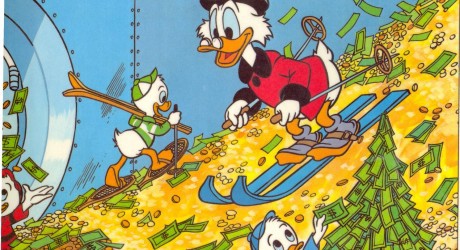
No, companies do not sit on vast swimming pools of gold coins, like Scrooge McDuck. One company's "cash" is a short term loan to another company, which the latter uses it to make real investments. Every asset (paper) is also a liability, backed by an investment. The charge fails to track the money.  One of the few things economists know how to do is always to ask, "OK, and then what do they do with the money?" Money is a veil, and real decisions are (to first order) independent of financial decisions. (I use italics to suggest some ways to remember these basic economic ideas.)


Suppose company 1 gets a tax cut, doesn't really know what to do with the money -- on top of all the extra cash the company may already have -- as it doesn't have very good investment projects. It  sends the money to shareholders. Well, what do shareholders do with it? (Hint: track the money.) They most likely roll the money in to other investments. They find company 2 that does need the money for investment, and send it to that company. In the end, they only consume it if nobody has any good investment ideas.

If company 1 doesn't have any good investment ideas, even after the tax cut, and company 2 does have some good investment ideas, made better after the tax cut, the economy needs to get money from company 1 to company 2. Company 1 could buy company 2; company 1 could invest in company 2 by buying its stock or buying its debt (all that "cash" you hear about); company 1 could return money to shareholders, and the shareholders could invest in company 2. They're all the same, to economics. Of all the ways to do this, actually, the last might well be the most efficient. Shareholders might have better ideas about good investments than managers of a company that doesn't have any good investment ideas.

The larger economic point: In the end, investment in the whole economy has nothing to do with the financial decisions of individual companies. Investment will increase if the marginal, after-tax, return to investment increases. Lowering the corporate tax rate operates on that marginal incentive to new investments. It does not operate by "giving companies cash" which they may use, individually, to buy new forklifts, or to send to investors. Thinking about the cash, and not the marginal incentive, is a central mistake. (It's a mistake endemic to Keynesian economics, but the case here is supply-side, incentive oriented.)

The point is the same as one I made in an earlier post, not to expect "repatriation" of corporate profits to make much difference to investment. Apple Ireland could already put money in a bank that lends to a US bank that lends to Apple US, if that money's best use was in the US. The marginal profitability of investment is all that matters.

Now, let me also quickly grant that there are second-order effects and frictions. Perhaps due to "agency costs," internally generated cash is a cheaper source of investment funds than cash obtained by issuing stock or borrowing. In that case, financing decisions do matter. Tracking down this sort of thing is what makes economics fun. But good economic analysis always starts with the relevant budget constraint or neutrality theorem, and then adds the frictions. Neither Ms. Guthrie nor Ms. Noonan had such a second order financing friction in mind.

Do not take this post as criticism of either author. They just happened to repeat the charge, which is floating around as part of the larger talking-point battle surrounding the tax cuts. Ms. Guthrie is an anchor trying to lob nasty questions, and Speaker Ryan could have answered this way. He chose a better answer in fact, recognizing that like "fantasy world" it was not a serious question. Ms. Noonan is a political commentator, and this minor fallacy does not detract from her interesting, larger, political point: Forget that returning cash to investors who quietly put it in better companies is economically efficient. If large companies are seen to just hand out presents to investors rather than to invest the funds internally, the political optics of the tax cut will be bad for its defenders. Sometimes paying attention to fallacies can be good P. R. It is, however, the job of economists as public intellectuals (subject of an upcoming post) to patiently point out this sort of thing, so maybe someday voters will not confuse P. R. stunts with progress.


Read more

Jumat, 22 Desember 2017

The High Cost of Good Intentions

The High Cost of Good Intentions is a superb new book by my Hoover colleague John Cogan. It is a political and budgetary history of U.S. Federal entitlement programs. It is full of lessons for just why the programs have expanded inexorably over time, and just how hard it will be for our political system to reform them.

If indeed the Congress will now turn to entitlement reform, as house speaker Paul Ryan has promised, this will be the book to have on your desk. (Ryan already blurbed it (back cover) as did Bill Bradley, Sam Nunn, George Shultz and Alan Greenspan.)

If you think entitlement programs, and the political hash that enacts them, are recent problems, or the fault of one political party, think again. John's main lesson is that the emergence of bloated entitlements is a hardy feature of our (and many other countries') democracies.  He does this by just reading the history.

The habit of expanding entitlements started early. Chapter 2:
Revolutionary War pensions were the nation's first entitlement program. ... between 1789 and 1793, the federal government agreed to pay annual pensions to Continental Army soldiers and seamen who became disabled as a result of wartime injuries or illness. [later, as an inducement to service]... 
For forty years, Congress enlarged and expnaded these benefits until, by the 1830s, they covered virtually all Revolutionary War seamen and soldiers, including volunteers and members of the state militia and their widows, regardless of disability or income. 
That costs might balloon beyond forecasts was not a total surprise


Opponents of the 1818 law predicted that granting lifetime pensions to Revolutionary War veterans who were "in reduced circumstances" would be costly. Senator Nathaniel Macon of North Carolina observed, "Pensions in all countries begin on a small scale and are at first generally granted on proper consideration, an that they increase till at last they are granted as often on whim or caprice...[it] will on experiment, be found an endless task. It will drain any treasury, no matter how full." 
Yet, the service pension law of 1818, which granted such pensions to all revolutionary war veterans who were "in reduced circumstances"
produced a massive surge in applications and an unexpected and unprecedented cost to the Treasury. The law's proponents had estimated that fewer than two thousand veterans would qualify and that the annual cost might reach $115,000. But by the end of 1819, more than twenty-eight thousand individuals had applied... The 1818 law's annual cost to the Treasury had ballooned from $300,000 to a staggering $1.8 million. ..widespread charges of pension fraud and corruption. A law designed to assist destitute veterans was providing pensions to many financially well-off veterans and even many who had never fought for the nation's independence. 
...Congress's underestimate of the cost was on the first of many underestimates. These miscalculations are invariably due to Congress's failure to appreciate how an offer of entitlement assistance can cause individuals to change their circumstances to qualify for aid they have previously managed to live without. 
This is a familiar theme in entitlement programs, but just how far back it goes was news to me.

A bigger theme of the book is the politics of entitlements. That also starts long ago. Congressman Dudley Marvin of New York reports
"In the villages in his part of the country, when the semi-annual pay day arrived, they [pensioners] were in the habit of forming themselves into companies, then forming a column and thus marching to receive their quota of the public bounty" 
This spectacle served as an early hint of the sense of entitlement that can affect groups of recipients of public assistance... such groups can develop an expectation that society owes them benefits that initially were bestowed out of gratitude for military service or a desire to alleviate hardship. We will observe this expectation and the sometimes remarkable behavior it generates in later chapters on twentieth-century entitlements. 
For example, a century later, the linkage between individual payroll taxes and benefits was crucial to the "enactment, long-run endurance, and, ultimately high cost" of Social Secrurity
Paying payroll taxes gave [gives!] program participants a sense that by contributing to the program during their working years, they were establishing an earned right to benefits when they retired. ... Senate Finance Committee chairman Walter George noted" Social security is not a handout; it is not a charity; it is not relief. It is an earned right based upon the contributions and earnings of the individual.  
When [President Roosevelt] was challenged about financing Social Security with a regressive payroll tax rather than general fund revenues from the progressive income tax, he replied, "We put those pay roll contributions there so as to give the contributors a legal, moral, and political right to collect their pensions and their unemployment benefits. With those taxes in there, no damn politician can ever scrap my social security program. Those taxes aren't a matter of economics, they're straight politics" 
Civil war pensions followed the same path, on a larger scale
The civil war pension program began with the same high-mihnded, noble, and limited goal as Revolutionary War pensons: to compensate soldiers for the loss of life and limb suffered in wartime service to their country... A half-century later the program evolved into a general disability and retirement program for virtually all Union soldiers...Congress also eventually stretched eligibility for pensions to virtually all widows and survivors of union soldiers, even those who had married many decades after the war had ended..
Costs ballooned, for example on the 1879 arrears law, that allowed soldiers to file disability claims after the original deadlines
The bill's senate floor manager, Sentaor John Ingalls, had put the total at $18 to $20 million. Hayes administration officials estimated a much higher cost of between $50 and $150 million. ... Two years after the law's passage President Chester A. Arthur reported that arrears payments had already cost taxpayers $235 million...It is fair to conclude that the law added nearly $400 million to pension expenditures during the 1880s alone  
New interest and lobbying groups emerged
claims agents led the advocates for arrears payments. These agents, certified by the pensions office, assisted veterans and widows with the complex application process, represented claimants in appeals before the pension office, and received compensation for their services. ... claims' agents had emerged as a powerful lobbying force. 
... The arrears act also spawned a second large national lobbying force: The Grand Army of the Republic (GAR). The GAR's evolution from a service organization ta special interest lobby..would be followed time and again by twentieth-centry lobby groups...
At this time, politicians discovered how important entitlements could be to electoral success, beginning the mad use of public money to buy votes that we see today.
The (1884) election campaign witnessed the use of the Pension office as a political machine to gain partisan advantage. (good story follows) 
... Along with this legislation came an important and powerful discovery by the Congress and the executive branch: broadly distributing cash benefits directly to a large segment of the voting population could produce significant electoral advantages. 
The story repeats again with WWI veterans.

There are occasional retrenchments and reforms, especially useful to ponder now.
Candidate Cleveland renewed his previous campaign promise to `cleanse the pension rolls and limit ... benefits to 'worthy' veterans. ...Voter backlash against the tariff and pension corruption contributed to President Cleveland's landslide victory.... Cleveland took immediate actions... The GAR rallied against this minor reform as if the pension rolls had been purged, decrying "false economy which shaves and pares to the quick at the expense of honor, justice and principle." ... by the time Preisdent Cleveland left office in 18997, there were 12,500 more Civil war pensioners than when he had taken office. 
Interestingly, Franklin Roosevelt was a great enemy of large veteran benefits. Roosevelt
shared the founding fathers' belief that all citizens had an obligation to serve their country in wartime, and therefore did not represent a special class of individuals entitled to government benefits merely because they had served during wartime. .. His views were decidedly at odds with Congress, which invariably concluded that all wartime veterans, especially when they reached old age, stood as a special class. 
 Roosevelt also thought balanced budgets were important. He acted cleverly:
On Sunday night, the President gave the first of his legendary fireside chats, reassuring the public that the US banking system was in should shape. On Monday he sent to Congress his third message: to modify the Volstead Act to permit the sale of beer... an extremely popular proposal. Now the Senate was in a bind. Under Senate rules, action on the Volstead act could not take place until the Economy act had been addressed... 
and they passed it
The law repealed all entitlements to pensions that had been granted to veterans of World War I, the Spanish American War, the Boxer Rebellion and the Philippine insurrection.. For the first [last?] time in US history, a large-scale entitlement had been repealed. ... 
Several factors account for President Roosevelt's remarkable success in reducing veteran's pensions. The economy and federal budget's dire situation presented the president with a national emergency, and in Washington such emergencies are a strong predicate for action.. President Roosevelt was also willing to use his veto power to sustain his policies... 
Roosevelt's attitude to veterans did not last.

*****

I'm up to the beginning, really, of the book, "The birth of the modern entitlement state." The centerpiece of the book is not these historical antecedents, but the political story of how the current US entitlements system evolved.

That story starts with the New Deal. It also brings in the judiciary, the "role of the federal courts in making public policy:"
The new Deal entitlements ushered in a new era for the federal courts. ... once federal entitlement rights had been granted, the nature and extent of these legal right had to be adjudicated....In the 1960s and 1970s, the federal courts .. expanded[ed] the legal rights of entitlement claimants in welfare, health care, and nutrition. Ultimately federal court decisions created welfare entitlement right where none had been legislated. 
There are many more themes worth stressing, even in the ancient history, and I won't prolong the quotes delicious as they are.

One theme: Our government routinely liberalizes entitlements when budget surpluses are strong, and at least slows down their expansion in bad fiscal times. It also liberalizes entitlements in bad economic times.

That bears centrally on the current reform question.  Our entitlements are, no surprise, on an unsustainable path. We will either reform them, in a way that reduces federal spending, or we will substantially raise taxes on the "middle class," including a large payroll tax increase and likely a european style VAT on top of growth-killing income and corporate taxes.

If one wishes for a reform on the expenditure side, the great question is whether it must be done directly or via "starving the beast" of tax revenue. For example, I advocate a VAT. A common complaint is that the VAT is not only a much more economically efficient way of raising a given revenue, it is a great way to raise much more revenue, and my critics complain it soon will do that and provoke even greater spending. The VAT shifts the top of the Laffer curve to the right, and in my critics' view, the US government will operate at the top of the long-run Laffer curve given structural limitations on its tax code.

I have held out hope that our democracy could contain itself to spend less than the top of the Laffer curve allows, so we can jettison the insane inefficiency and corruption of our tax code, and have one that is vastly more economically efficient. The opposite view really amounts to belief that democracy is fatally flawed. Moreover, I note that starve the beast tax reductions have led to massive deficit expansions, yet large debt and deficits have not yet seemed to provide much pressure against entitlement spending.

John's history is a strong push toward starve the beast, at least in the negative direction. Surpluses lead to benefit expansions, quickly.

Another theme: The accounting gimmicks such as "trust funds." Surpluses in trust funds lead to benefit expansions, even if there are huge deficits outside. And "trust fund" accounting gimmicks also go back a long way.

As we (hopefully) start to think about reform, I think the only hope is to break out of "we're spending too much there will be a debt crisis" vs. "you heartless evil person, just look at (deserving person). How can you throw her off the bus." The way to do that, I think, is to focus on the disincentives of our social programs, not on the cost or the worthiness of recipients. I find some comfort in John's history, that occasional retrenchments, including the above and the welfare reforms of the 1990s got through politically by looking at fraud (a form of disincentive) and other disincentives.

This is a history and a political history, not a reform proposal, nor an economic analysis of disincentives. Still, John's history is also full of quotes reflecting the centuries old tension in welfare programs between helping those in need and disincentives, which I'll cover in the next post. That history ought to help.

A note for graduate students: This book is very well written, and you should read it to emulate writing style as well as for the subject. No, it does not knock you over the head with beautiful sentences as John McPhee might. It is, however, beautifully structured. The whole book and each chapter starts with a complete summary of the argument, and the chapter fills it out. It could go on for thousands of pages, but manages to tell just enough of the story so you see the historical detail, but not enough so you get lost in what must been have fascinating historical detail. Yet this is not a standard quickie book aimed at a policy controversy. This is a deep piece of scholarship. Everything is footnoted -- 78 pages of footnotes and reference all together.


Read more

Rabu, 13 Desember 2017

Asset Pricing Competition


John Campbell's text, "Financial Decisions and Markets" is out from Princeton University Press. With some mild chagrin, I must say it's a splendid book. (Chagrin, of course, because it's an obvious major competitor to my own effort in Asset Pricing.)

It is spare, concise, and clearly written. How can I say that of a 450 page book, with wide text and tiny margins? Well, it's the concise version of the Encyclopedia Britannica, breathtakingly comprehensive and up to date in its coverage of important research topics.

The first part is a whirlwind tour of asset pricing theory. Here, John adopts the traditional organization -- expected utility, static portfolio choice, static CAPM and APT as equilibrium relations where supply meets demand, and finally we meet the discount factor and consumption-based pricing. I chose to go the other way around, and start with the basic asset pricing equation \(p_t u'(c_t) = E_t [\beta u'(c_{t+1}) x_{t+1} ]\), following Bob Lucas' insight that asset pricing is the same as in an endowment economy, and filling out the CAPM and APT and so forth as special cases. I never even got to portfolio theory -- it's in a draft chapter for the long-delayed next version. I still think that's the right organization, but most people don't want to teach it that way. John's more conventional organization, combined with clarity and concision, may be more what you want.

Even here, John's empirical taste and contributions rings through Any textbook is in many ways a summary of its authors' research journey, and John's journey has gone far and wide. You see a preview of the style on the 6th page of chapter 2 (p. 28) where you meet approximations for log returns, and the growth-optimal portfolio on the next page. On calculating minimum-variance portfolios, on p. 37, you get  graph of time-varying return correlations from Campbell Lettau Milkier and Xu (2001), a provocative fact usually ignored. After efficiently presenting the classic CAPM, we get (p. 51) an insightful application to Harvard's endowment, highlighting the difficulties of using these oft-repeated portfolio and pricing theories in practice.
This book is  infused with up to the minute empirical work and practical application even in the most basic theory sections. Starting on p. 61 John moves swiftly from the CAPM theory to empirical evidence, and implicitly, methodology. The next 16 pages cover the standard regression test approaches, swiftly show the evidence for the value and size cross sections, a nice treatment of momentum, a good yet economical coverage of the major anomalies and then a quick and digestible survey of reactions such as conditional capm, multifactor models, and behavioral finance. The coverage is comprehensive and up to date without being overwhelming.

Then the book really gets going. You would expect Chapter 5 on present value models to be excellent, and it is, somehow while also being brief. It covers not just the basics such as Campbell Shiller present value model and VARs, but includes a useful section on "Interpreting US stock market history" to bring equations alive, an excellent section on the econometrics of return forecasting, drifting steady state models, present value models in the cross section and more. Somehow in 40 pages John has distilled his own major research contributions, and several hundred papers of a still active literature, yet brought you up to date. My coverage focused only on the simplest idea, and wasn't one tenth this complete a summary of the current literature.

Chapter 6 on consumption based asset pricing is likewise elegant and comprehensive. John jumps right in to data with the equity premium, riskfree rate, and volatility puzzles (p. 164). Then he quickly outlines the huge literature of responses to the puzzles (p. 167) again in short digestible paragraphs. The big ones, time varying disasters, Epstein-Zin, long-run risk, ambiguity aversion and (nearly last but not least) habit formation and durable goods each get a few well-chosen pages, each self contained with derivations (a derivation of the Epstin-Zin SDF is not fun), but not windy. Unusually, John also includes an elegant chapter 7 on production-based asset pricing and general equilibrium. I think this approach is relatively unexplored and promising -- I'm glad to infer John agrees. In both areas, my latest survey in Macro-Finance is not nearly as economical. John spryly gets to the point.

It wold not be a John Campbell book without a chapter on fixed income, and this one does not disappoint. Affine models, empirical work on the expectations hypothesis, a strong emphasis on the link between macroeconomics and term structure - absent in most treatments -- and linking interest rates and exchange rates are strong points.

Here though, you see one limitation of the book, in scope at least. Everything, including fixed income, is done in discrete time. This fact certainly makes it more accessible to economists, and most of John's voluminous work has been in discrete time. But most of the ideas in asset pricing are much easier in continuous time, once one masters the elements of Ito's lemma manipulations.  Term structure models are commonly done in continuous time. In revising Asset Pricing and the online versions, I have moved entirely to continuous time rather than lognormal approximations. It's much simpler that way, and continuous time is a standard part of a finance PhD's toolkit. This otherwise comprehensive book doesn't have any option pricing in it, though Black-Scholes is a cornerstone of finance. Well, John hasn't worked on that, and his research is mostly presented in discrete time. Adding continuous time would add a lot of pages. It keeps the book quite self contained. But it does mean that a course in finance will need some other reference material for that important part.

The next three chapters reflect again many of John's wide-ranging contributions.  It is a crime that we still use static mean-variance optimization -- and by "we" I include the entire industry as well as academia -- when we know state variables are moving around all the time. John has made some great strides in trying to make intertemporal portfolio allocation and inter temporal asset pricing come alive. There is a lot left to do here, but if you want to get started Chapter 9 on inter temporal risk brings you up to date (or at least faster than trying to read all of John's papers!)

Chapter 10 on household finance is a great example of a topic that is new to the asset pricing canon. How do we understand what portfolios people actually hold?  You get a great summary of that work. It's followed by an excellent Chapter 11 on the economics of risk sharing and speculation and Chapter 12 on asymmetric information and liquidity. This too is not yet part of the textbook canon but soon will be, as these issues are central to current research.  The classic theory of finance, the joke goes, is perfectly mirrored in the market for senior faculty: Prices change, there is no volume. There is a recent explosion in understanding the mechanics of trading, and these spare chapters will send students on their way.

Like continuous time, the book also does not have a chapter on the recent explosion of models in asset pricing with financial frictions. Perhaps John just hasn't written in that area yet! But an author (me) whose finance book omitted a chapter on portfolio theory can hardly complain, and knowing John's evident mania for scholarship, it will likely be there in the revision.

In sum, this is a must-read book for any Ph. D. student in finance or financial economics, and must-have book for any serious scholar of finance. It is not organized, as I tried to do in Asset Pricing around a Big Idea, trying to move how we do research in a particular direction. That is likely an advantage. Instead, it shines in a crystal-clear, nearly encyclopedic summary of current ideas in the macroeconomics and finance literature, complete with an equally encyclopedic citation list for those wanting to go further. It is distilled like fine scotch. Barrels of fine scotch.

Read more

Rabu, 15 November 2017

Journal graphics in a bygone era


To illustrate MV = PY. (It was MV=PT then.)  In  Irving Fisher, "The Equation of Exchange 1896-1910," The American Economic Review Vol. 1, No. 2 (June, 1911), pp. 296-305, via JSTOR.
Read more

Senin, 13 November 2017

Two on energy subsidies

The WSJ has two good and related opeds on energy and transport subsidies recently, Randall O'Toole on Last Stop on the Light-Rail Gravy Train and Lee Ohanian and  Ted Temzelides write on energy and transport subsidies

O'Toole:
Last month, Nashville Mayor Megan Berry announced a $5.2 billion proposal that involves building 26 miles of light rail and digging an expensive tunnel under the city’s downtown. Voters will be asked in May to approve a half-cent sales tax increase plus additions to hotel, car rental and business excise taxes to pay for the project.
Just in time for self-driving Ubers to arrive.

I love trains. But we have to admit practicalities. One transportation economist summed all there is to know about transit with "Bus Good. Train Bad." (With a few exceptions, such as Manhattan.)  And light rail, worse. Trains are expensive, and once built, immobile. If people want to go somewhere else, tough. Rolling stock lasts around 50 years, meaning they bake in technical obsolescence. Trains carry far fewer people per lane-mile than busses. And a fleet of self-driving Ubers linked by computer will be able to use bus lanes.

Actually, even buses are more and more questionable. As I wait for the interminable lights on El Camino to cross to Stanford (on bicycle), I have taken to counting passengers on the well-subsidized bus line. The modal number is zero.

As Randy has pointed out elsewhere, the main beneficiaries of light rail are suburban largely white commuters with a nostalgia thing for trains. The main people paying for it are inner city minorities who don't get bus service anymore.
To pay for new light-rail lines that opened in 2012 and 2016, Los Angeles cut bus service. The city lost nearly four bus riders for every additional rail rider.
Congestion got you down? Real time tolling, adjusted minute by minute, will either cure traffic congestion forever, or will bail out indebted local governments with massive revenues, or both. Or, let people live somewhere near where they work!

Lee and Ted consider the transition from horse to auto and truck,
‘In 50 years, every street in London will be buried under 9 feet of manure.” With this 1894 prediction, the London Times warned that the era’s primary source of transportation energy—the horse—would soon create an environmental crisis. ...
The enormous demand for a cleaner and more efficient source of energy led to remarkable innovations in the internal combustion engine. By 1920 horses in cities had been almost entirely replaced by affordable autos and trucks...
And to be honest, horse manure replaced by auto exhaust -- but as bad as auto exhaust is, it's a lot better than horse manure.
Suppose governments in the 1890s, desperate to replace the horse, had jumped on the first available alternative, the steam engine. Heavy subsidies would have produced more steam engines and more research on steam technology. This would only have waylaid the development of the far superior internal combustion engine. 

Source: Obtainium works
(Actually, the government did subsidize railroads a good deal, and perhaps by doing so did stall the development of the truck.)

More than horse manure, I love the image of an alternate reality steampunk America...At left a cool  steampunk RV. (Image source)

Which brings us back, I'm afraid to the main force behind rail subsidies, which Randall has pointed out before: Nostalgia. Nostalgia for what seems like a simpler age. I understand that too. I love trains. But that doesn't make them practical, especially at billions of dollars per mile.

If we're doing nostalgia, how about doing it full time -- high speed stagecoach lines? Bring back the horse! It's all renewable!'
Read more

Kamis, 02 November 2017

Yellen Retrospective

The newspapers report today that President Trump has decided to nominate Jerome Powell to replace Janet Yellen as Fed Chair.

The Federal Reserve's mandate is to "promote maximum employment, stable prices, and moderate long- term interest rates." Ms. Yellen can look back with pride on these outcomes during her term:


All three variables are doing better than they have in half a century. Many people complain about many things at the Fed, including me, but relative to the stated mandate, she has every right to put these charts on the wall of her new office.

One could complain that Ms. Yellen didn't face any particular challenges. As presidents are tested in wartime, so Fed chairs are tested by events. Ms. Yellen didn't face a recession or financial crisis. In this quiet late summer of the business cycle, her job was largely to do nothing, and resist calls from people who wanted her to take big steps. The Fed's major tool is the federal funds rate, has barely moved.


True, but she did not screw up either. So much of monetary history consists of unforced errors, that not making one is an accomplishment. The late summer of business cycles has historically been a time when central bankers over or under react.  And there has been no lack of loud voices calling for drastic action one way or another. In particular, the siren song of "macro prudential policy" that the Federal Reserve should manipulate stock and housing prices has been strong. Her predecessor, Ben Bernanke, will be much more written about for the Fed's management of the 2008 crisis and recession, as well for its failure to see it coming in 2007.  Not screwing up doesn't earn you as big a place in history, but perhaps it should.

No matter how one feels about monetary policy, and the more important (in my view) question of Fed financial regulation, President Trump is breaking with tradition by not reappointing her. The tradition that if the Fed chair has done a reasonable job, he or she is reappointed is a good one for maintaining the independence of the Fed. Let us hope that it is not gone for good.

Good luck to Ms. Yellen in her next endeavor. And to Mr. Powell in this one.

Read more

Jumat, 27 Oktober 2017

Economists and taxes

My last post on taxes continued the question, who bears the burden of the corporate tax? Will a reduction in corporate taxes benefit stockholders or workers? It was a fun technical discussion.

But the whole time I want to scream: That is the wrong question! And the public economists job should be to scream from the rafters, that is the wrong question!  By just accepting the question, we are doomed to bad answers.

The public, and politicians, analyze taxes entirely through the lens of who gains and who loses. Income redistribution, yes, but also redistribution from renters to homeowners, married to unmarried, young to old, city dwellers to farmers, Texans to Californians, and so on. The political and popular discussion is about taxES, and who pays what.

Economists serve best when they offer thoughts outside the standard left-right partisan divide. Our first function should be always to remind people that marginal tax rates matter to the economy not taxes. 

Our second insight is always to analyze things comprehensively. The Federal income tax is not what counts, the entire wedge between work and consumption matters. Whether the corporate tax is progressive or not does not matter, whether the overall tax code is progressive (plus the overall spending code, and forced cross-subsidy code!) matters.   Don't tax wine over beer to redistribute; tax goods evenly and achieve progressivity through a progressive income (or better, consumption) tax, or spend money on programs to help people whose distress is correlated (imperfectly) with beer drinking.

Economists may feel their moral sentiments about redistribution are really important. But we have little professional reason to argue our feelings are better than anyone else's. What we can argue is, if you'r going to do more or less redistribution, do it efficiently and comprehensively.

In this context, the current tax reform proposal, and its instant dismissal from self-identified Democratic economists, echoing political rhetoric, is a deep disappointment.

The economists' tax reform starts with a detailed breakdown by income. (I'm caving to political reality that our nation is obsessed with income, not more meaningful measures of economic advantage and disadvantage.) Then, we create a tax reform in which each group pays the same amount (ideally, bears the same burden), but trades lower marginal rates for fewer deductions, exemptions, and for the reduction or elimination of taxes that either highly distort economic activity or lead to lots of inefficient avoidance  (corporate, rates of return, estate).

In short, we aim for a revenue-neutral, redistribution-neutral, reform. We recognize that eventually tax rates must be high enough to cover spending. There isn't a big need to argue over Laffer effects. Even if scored as statically revenue neutral, when the economy booms, revenue flows in, and we have paid off the debt we can start lowering rates. We recognize that if the structure if the tax reform is fixed, we can later continue to argue over the right amount of redistribution.

1986 came close. It wasn't perfect. But at least the rhetoric was this, and politicians explained this goal to the public. You will pay the same taxes, but at lower rates for fewer deductions, and the economy will grow. And lo, it did.

For thirty-one years, we have waited to finish the job. As the tax code grew more complex, with higher statutory rates and more deductions, we waited to redo the job. Reform proposal came and went, with at least a nod to this amount of economic sense.

But no more. Now tax policy is all redistribution all the time. Democratic politicians have decided that their mantra is "tax cuts for the rich." Well, a slogan is a slogan. More sadly, self-identified democratic economists echo this mantra, and little other. Anytime you're arguing one side's talking point or another, you're doing little to illuminate a discussion.

Each provision is examined in isolation for its redistributive impact. It's profoundly hypocritical of course.  Tax deductions are indeed a "tax cut for the rich" since people in the 40% marginal bracket who itemize get a lot more than Joe and Jane down in the lower brackets. But you hear either silence, or pretzel logic defense, such as the New York Times defense of the profoundly regressive deduction for state and local taxes.

I was disappointed at both the rhetoric and the small progress of the administration's proposal's to date. Yes, cutting the corporate rate is a good idea. But they don't even try to argue for marginal rate reductions or incentives. The buzzword is to give "tax cuts to help the middle class," which the left can then argue is a "lie" or not. Once you fall for redistributionist rhetoric, once you say that tax policy is all about giving the right people more and the wrong people less money, I think the hope for a tax reform that actually gets the economy going is dim.

The holy trinity was off the table from the start -- home mortgage interest deduction, charitable deduction, and employer-provided health deduction. The fourth horseman of the apocalypse, the deduction for state  and local taxes, is in danger. (Sorry for mixing metaphors!) This is like a wayward husband saying, "sure, I'll clean up my act. However, the drinking, gambling, and smoking are off the table." The corporate tax reduction does not seem to be coming with a serious cleanup of the thousands of deductions and extenders, each catnip to the lobbyists who keep them in place.

The political challenge for a reform is to say to each group, "you're going to give up your deduction, yes even interest on future home mortgages. But, your rates will go down so much that you will end up paying no more overall, and as the economy grows you will pay less. I want your help holding the fort against those who will demand their deductions and subsidies." That's a deal that pretty much held together in 1986. But if we go into the negotiation saying "oh, and by the way the big three are getting theirs unscathed," and "therefore really big rate reductions are off the table," then the hope of putting that coalition together is gone. It's  a free for all, call your congressperson and make sure you keep yours.

The bottom line: I support the current tax proposal, as incomplete and flawed as it is. It is a step in the right direction. We get the corporate tax rates down to those common in that low-tax free-market nirvana, Europe. It is not, however, 1986 on its own.

I do not support the rhetoric. "Tax cuts" do not work absent spending cuts. Cuts in distorting marginal tax rates matter. The people in charge must surely understand this, so the choice to market it as "tax cuts for the middle class" represents, I think, an unwise rhetorical choice.  The American people are smart enough to understand this, and playing redistribution, bidding for support with handouts, is not a winning game.

Moreover, the sense I have from talking to people, less enshrined in economic theory, is that massive tax complexity and uncertainty are larger drags on growth than a stable simple but high tax rate would be. I see "simplification" in the rhetoric, but no substantial simplification in the body of the proposal. It leaves most of the "finish 1986" job undone, and unless magic happens on entitlement reform, this tax bill will be undone soon as the deficit widens. If it is all we get, and if it is passed as Obamacare was passed, with no votes from the other party, it will not give the sense of permanence necessary to induce a lot of investment and growth.

It needs to be a first step, not this generation's tax reform for the next 31 years. I understand the politics. Republican leadership needs to do something. If Democrats will unite in "resistance" to a bill celebrating mom and apple pie, they need to do something on their own. If they do something, and look like winners, they can get support to do more. But it must be that first step. And even so, I would have hoped for some more courage in the first step. Enshrining the triplet of deductions without  a fight, not even mentioning marginal rates, makes it ever harder to remove them in a second step.

And I wish I were hearing a lot of this, and not just echoing the political line "tax cuts for the rich," from top economists more critical of the proposals.


Read more

Corporate tax burden again

This post continues the question, who bears the burden of the corporate tax? The next post will have broader thoughts on the tax plan and economists' reaction to it.

I'm responding in many ways to Larry Summers, who weighed in on the corporate taxes issue in a Washington Post oped. He eloquently and concisely makes most of the arguments floating around now against the corporate tax cut, so I don't have to wade through the venom in Krugman posts to find nuggets of economic sense that one discuss on objective grounds.

This is a long post, so let me summarize the conclusions

1) Even if stockholders do bear the burden of the corporate tax, that is entirely the stockholders who are there when the tax is announced. Current stockholders bear little or no burden.

2) The novel "monopoly" argument is seriously deficient.

3) Even if stockholders bear the burden of the corporate tax, the corporate tax is an insanely inefficient way to make a more progressive tax code.

So who does bear the burden of the corporate tax? 

I think every economist in this debate admits, if some reluctantly, that "corporations" pay no taxes. As an accounting matter, every cent corporations pay comes from higher prices, lower wages, or lower payments to shareholders. The only question is which one.  And indirect general equilibrium effects are central.  The question is not just, how do corporations respond immediately, but how do wages, prices, and capital in the whole economy adjust. "Make corporations pay their fair share" is just nonsense.
The sales tax is a good place to start thinking about this question. Corporations "pay" sales taxes, but It's a natural first guess if the sales tax were abolished, prices would stay about the same and we'd pay less overall. Customers "bear the burden" of sales taxes. That's the same thing as saying the sales tax comes out of the wage, as wages only matter relative to prices.

I doubt anyone's first guess would be that companies would raise prices one for one with the reduced sales tax, and stockholders would get higher dividends. We also might guess that companies would sell more, raising output, and try to hire more people increasing employment and wages.

(Let me add quickly that these effects of sales tax are not obvious when you do the economics right. This is just an example to help people see that who pays the tax isn't necessarily the same as who bears the burden of the tax. )

Now, who bears the burden of the corporate tax? The usual principle is that he or she bears the burden who can't get out of the way.  So, how much room do companies, as a whole, have to raise prices, lower wages,  lower interest payments, or lower dividends? It used to be thought that it was easy to lower payments to shareholders -- "the supply of savings is inelastic" -- so that's where the tax would come from. The newer consensus is that companies as a whole have very little power to pay less to investors, as you'll see in detail below, so the corporate tax comes from lower wages or, equivalently, higher prices. Then, indirectly, reducing the corporate tax would increase capital, which would result in higher wages.

Which stockholders bear the burden

Summers disagrees, feels that stockholders bear most of the burden of the corporate tax, so lowering the corporate tax would primarily benefit stockholders, as explained in his  Washington Post oped

Let's start with this:
The main point of my [justly famous 1981] paper ... was that because of slow adjustment costs, the impact of tax changes was felt primarily on asset prices for a long time. This meant that as my paper showed, the primary impact of a corporate tax cut would be to raise after-tax profits and the stock market. This in turn, as I noted, primarily benefits wealthy individuals. 
Let's unpack that. Suppose for a moment that essentially all the corporate tax comes out of lower dividends, not higher prices or lower wages. And let's even leave new investment off the table, either because adjustment costs are large (Larry) or out of the feeling that corporate profits come from some "monopoly rent" unrelated to the capital stock.

What happens then if we lower the corporate tax rate? As Larry points out, stock prices rise. If the company grows at the rate \(g\), then \[ P_t = \int_{s=0}^\infty e^{-rs} (1-\tau) D_s ds = (1-\tau) D_t \int_{s=0}^\infty e^{(g-r)s} ds \] \[P_t = (1-\tau)\frac{D_t}{r-g}\] Reducing the tax rate \(\tau\) raises the stock price, and, here, does nothing else.

But think about how this works. The day the corporate tax is announced, the stock price drops by the new tax rate. Then the price stays low, but the return is the same as before. You pay a lower price to get the lower dividend, leaving the return the same, \(r\) here.

So the entire corporate tax is pre-paid, or borne, by the stockholders who are unfortunate enough to be around when the corporate tax is announced.  Anyone who buys shares after the corporate tax is imposed gets the shares at a lower price, so his or her return is entirely unaffected by the corporate tax.

People who buy shares after the corporate tax is imposed bear no burden of the tax. The corporate tax does not affect the rate of return received by current owners at all, because they got to buy at low prices.

So much for corporate taxes soaking the rich. This is an important fact, missing in all the distributional analysis I have seen.

Now, think about lowering or (let us hope, someday) repealing the corporate tax. In my grossly simplified example, as in Larry's claim, the only impact will be to raise stock prices, and to give a big burst of value to whoever holds stocks on the merry day that the tax cut is announced.

Larry claims that this "primarily benefits wealthy individuals." Well, maybe (more on that later). But Larry leaves out that, if so, we are only giving back some of what was taken on the day that the corporate tax was announced. Maybe right, maybe wrong, but this is not a gift, it is a partial restoration. Since Larry's point is entirely about redistribution, this is not an inconsequential point.

You may object,  most shares have changed hands, so it is a restoration to different people, and in that sense maybe a gift. But it is not a pure gift.

Alexander Hamilton faced a similar issue with revolutionary war debt. A lot of this debt had been bought by soldiers, but as the chances of the debt being repaid declined, its value declined. Many soldiers sold their debt for pennies on the dollar to "speculators." By proposing to pay back the debt at face value, restoring the previous value of the debt, Hamilton did something that primarily benefitted these "speculators." Assuming the state debts was surely a "handout to the rich," bondholders then being like stockholders now plausibly better off than the average citizen. The bonds were a sunk cost, as Larry views today's capital.  But Hamilton did it, for reasons that now seem wise. Fortunately, not every decision revolved around redistribution then.

Larry's case, that capital is fixed in the short run, amounts to the usual argument that the government can grab existing wealth without distortion, so long as it promises "just this once" and not to grab future wealth. Alas, the "just this once" promise has proven futile in the past, and wealth holders learn not to save. Hamilton, among other things, bought reputation, vital when the country needed to borrow again. Larry is mostly worried about giving a present (or returning a theft) to current owners of capital, never mind the "long run" of capital formation. But reputations matter, and the long run comes quicker than you think, a fact those of us of a certain age can tell you.

You may object to all this that we have not  seen any big stock price movements along with rather substantial changes in corporate taxes over history. I agree. Which points exactly that the first assumption is wrong -- that corporate taxes don't come out of dividends in the first place, but rather out of prices and wages. And if the price didn't go down when the corporate tax was imposed, it won't go up when the corporate tax is removed.

Is the rate of return really constant? 

Larry would quickly object to my example that I held the rate of return constant as I changed the corporate tax rate.  Larry disputes that assumption:
Second, neither the Ramsey model nor the small open economy model is a reasonable approximation for the world we live in. In the Ramsey model, savings are infinitely elastic, so the real interest rate always returns to some fixed level. In fact, real interest rates vary vastly through space and time, and generations of economic research show that the savings rate rather than being infinitely sensitive to the interest rate is almost entirely insensitive to the interest rate. 
The United States is not a small open economy. If it were, the effect of an effective investment incentive would be a major increase in the trade deficit as capital inflows forced an excess of imports over exports. I imagine that President Trump at least feels that a greatly augmented trade deficit is not good for American workers. 
Let me unpack those arguments. You are a "small open economy." The rate you pay at the bank is the same no matter whether you borrow $100 or $1000; the price you pay at the grocery store is the same whether you buy one or 20 bananas. You're not big enough to affect market prices.

The "small open economy model" says, as I have above, that if dividends and other payments to shareholders are reduced by taxation, the price of US stocks will fall until the rate of return is the same as it is in the rest of the world. The "marginal" investors whose actions determine stock prices can buy here or abroad, and they will simply sell or try to sell, pushing prices down, until their prospective risk-adjusted after-tax return is the same here as it is abroad.

The "Ramsey model" proposition is more subtle.  Any attempt to make people suffer a lower rate of return induces them to save less. Less savings means less investment and the capital stock falls. This keeps going until the before-tax marginal product of capital rises enough to pay the tax and give investors the original rate of return.  The long-run after-tax return to investors is always the same. This argument is entirely domestic, and doesn't rely on any international investors. (Many commentaries ignore this, more important, effect and just talk about whether the US is big or how open capital markets are.)

This proposition is behind the now classic result that the optimal capital tax -- the corporate tax and personal income taxes on rates of return -- is zero.  (Chamley 1986 and Judd 1985.) It lies behind the modern move to consumption taxation and away from trying to tax wealth and rates of return, including the Obama administration's well-noted efforts to reduce corporate taxes. It's why we have 401(k)s, dividend and capital gains rates lower than ordinary income, capital gains step up at death, and so on. It's why most countries have a VAT and have already reduced their corporate rates.

Here's my best attempt to explain this result, beyond the previous two paragraphs.  The most basic equation in macroeconomics is \[ r = \delta + \gamma g \] where \(r\) is the rate of return, \(g\) is the economy's growth rate, \(\gamma\) measures how reluctant people are to rearrange consumption to have less now and more later, and \(\delta\) measures how impatient people are. (This, together with \(r=f'(k)\) are the \(E=mc^2\) of modern macroeconomics.) A higher growth rate \(g\) means people consume less today than they expect consume tomorrow, and people must receive a higher after-tax real return \(r\) to defer consumption.  (This equation is the continuous time version of \[ u'(c_t) = \beta R u'(c_{t+1})\] using the standard \(u'(c)=c^{-\gamma}\).)

Now, none of these tax arguments are (yet) about the long-run growth rate of the economy. Reductions in marginal rates raise the level of output, and give a boost of growth along the way, but they do not raise the long run growth rate.  (Endogenous growth theory is not part of the argument. Yet.)

So, we have the "Ramsey" theorem:  If the long-run growth rate of the economy is unchanged, then the long run rate of return is unchanged.  

Larry did not have the (apparently endless) space I have, but it's not clear how he disputes this simple and classic result -- and, by implication, the vast changes in tax policy that it has produced. Larry notes only that "real interest rates vary vastly through space and time,"  and "generations of economic research show that the savings rate rather than being infinitely sensitive to the interest rate is almost entirely insensitive to the interest rate." Neither point has anything to do with the question at hand. The theorem did not say that interest rates are constant, merely that rate of return will revert after an attempt to tax it, over very long spans of time -- the time needed to reduce the capital stock and raise its marginal product. Similarly, the research Larry refers to is about high frequency correlations between expected consumption growth and interest rates. He is right here -- tests of my above equations in monthly and quarterly data don't work well. That should give big pause to the use of business cycle models, including the models used to evaluate stimulus programs, in which those equations lie front and center. But this is a long run proposition.

In fact, the central proposition works quite well at the medium and longer runs we are talking about. Consumption growth and real rates of return move together across countries and at medium and longer runs in a country. Economic booms and booming economies have higher rates of return. Economic busts and declining economies have lower rates of return. And that variation is why real interest rates "vary through space and time!" The variation proves the equation, rather than deny it. And to leave it at "savings is almost entirely insensitive to the interest rate" really puts the central question of the effects of corporate taxes outside of economics -- and is a tellingly static view of the world.

The central question is this: Seeing that dividends are (this is Larry's assumption) going to be heavily reduced by corporate taxation, do people simply fail to react and pay the same price for the stocks, and thus suffer a lower rate of return? That's what Larry asserts, and when you think about it that way seems pretty dubious. (Investment lines up with stock prices, not with real interest rates.)

The argument is also inconsistent. If people pay the same price and enjoy (tax cut) or suffer (tax increase) lower rates of return, then lowering the capital gains tax will not lead to a big stock price increase! You can't have it both ways.

You also may object that as we do not see variations in stock market values (P/D or P/E) when corporate tax rates change, we also do not see variations in average rates of return lining up with corporate tax changes.  Again, I would say this proves the point. That we don't see either price or return changes suggests that dividends do not bear the burden of the tax, but wages and prices do instead.

Monopoly

The latest argument for corporate taxation is that somehow there is now more "monopoly power" in US business, and this justifies a higher corporate tax. Paul Krugman has been advancing this idea most strongly. I'm always suspicious when the questions change but the answer doesn't, but still, let's unpack this argument. It goes together with Larry's point that full expensing of investment alone would offset many of the disincentives to capital formation:
First, a cut in the corporate tax rate from 35 to 20 percent in the presence of expensing of substantial or total investment has very little impact on the incentive to invest. Imagine the case of full expensing. If a company is permitted to deduct all of its investment costs and then is taxed on all of its investment profits, the tax rate has no impact at all on the investment incentive. ... 
...Mankiw’s model does not recognize the possibility of monopoly profits or returns to intellectual capital or other ways in which a corporate tax cut benefits shareholders without encouraging investment. 
Let me try, with some trepidation, to put the argument in equations which will clarify it. We had started this discussion in the last post with  a firm problem
\[\max (1-\tau) \left[ F(K,L) - wL \right] - rK \]
Notice by the way how a corporate tax is different from a sales tax. A sales tax only applies to output, so the firm problem is
\[\max (1-\tau)  F(K,L) - wL  - rK \]
The sales tax distorts the decision to hire labor. The corporate tax does not distort that decision -- we  have \(F_L=w\) because the tax applies to both of them.

But what if dividend payments were tax deductible? Then we'd have
\[\max (1-\tau) \left[ F(K,L) - wL - rK \right] \]
and the decision to invest would not be distorted by the corporate tax. Perhaps more clearly, suppose investment is financed by retained income, and investment expenditures are completely deductible. Then the firm's problem is   
\[\max (1-\tau) \left[ F(K,L) - wL  - K_{t+1}-(1-\delta)K_t \right] \] where \(\delta\) is depreciation.  Again if it's inside the brackets, the corporate tax does not distort the decision.

If you've taken an economics course, you quickly spy the problem. If the corporate tax lets firms deduct payments to workers, then lets firms deduct payments to capital, there isn't anything left! \(F(K,L)=F_K K + F_L L = rK + wL\). If economic profits are zero, and we tax economic profits, we don't distort any decisions, but we don't raise any money either.

So suppose now there is a monopoly element, so \(F(K,L) > wL + rK\), revenue exceeds payments to labor and the payments necessary to get physical capital. Now there is, apparently,  a profit, a pure rent, that can be taxed without distortion!

That is apparently the golden goose of public finance: some source of pure rent, some completely inelastically supplied factor, that can be taxed and does not distort any decision.

Then, and this is the crucial point, Larry (and Paul and company) are asserting that taxing corporate profits does not discourage investment in whatever is producing corporate profits, so it is non-distorting.

Well, is that true?

Here is where I get a little frustrated at the east coast approach to economic policy making. OK, there is a new idea floating around the right cocktail parties: "monopoly rents" are on the rise. So we must quickly "do something," or in this case offer a new reason for the same old answer, corporate taxes.

Really? If there is pervasive monopoly in the economy, why isn't the right public policy answer to do something about the monopoly? More to the point here, before we start taxing things, it is vital to understand what the source of the "monopoly" profit really is, and be really sure that taxing it will not discourage its production, just like that of physical capital. There is something to the story. Measures of entry and dynamism are indeed way down. Corporate profits and stock prices are high, but investment is not following them. High profits should lead to a desire to expand. But if you don't understand it, you can come quickly to wrong answers.

There are two natural stories for monopoly: 1) Government license. Just about every long-lasting monopoly in history is so because of government restrictions on entry and competition. Think taxicabs before Uber. We just had a huge increase in regulation of about 40% of the economy in Obamacare and Dodd-Frank, posing explicit and implicit barriers to entry. Regulation and compliance costs have increased dramatically in many other parts of the economy as well.  But if this is the case, government-created monopoly and then government taxation of its rents hardly seems like the ideal policy mix.

2) Intellectual property. Larry mentions this one. Google is, the story goes, a "monopoly" because it has intellectual property others can't match. Drug companies are "monopolies" because they have patents that allow them to charge high prices for drugs. Here I think Larry's (and, more vocally, Paul's) argument falls apart.  Intellectual property is not an exogenous fixed factor, the "land" of the land tax. Intellectual property is produced. If Google or the drug companies have rents to intellectual property, this is precisely the high rate of return that provides incentive for people to produce new intellectual property. And taxing it away kills that incentive. Go right back to Greg's math, and relabel "K" as intellectual property.

In sum, for the monopoly argument to go through, the monopoly rent must accrue to some really fixed factor, or to some economically wasteful investment such as lobbying. If the monopoly rent accrues to intellectual property, or anything else that must be produced, then we're right back where we started and corporate taxes damage economic growth, investment, and wages.

The argument is more pervasive. Corporate as well as personal income taxes affect people's decision to choose careers, to start a company rather than take a steady job as, say, an economics teacher. The subsequent profits may look like "rents," but they are returns to human capital investments, which will go away if taxed to highly.

Suppose there is, however, some permanent monopoly power, and it accrues to some fixed factor that current companies have, and will have forever.  Never mind how Google unseated the "monopoly" of AOL, Yahoo, and Netscape.  Even so, how monopoly power changes optimal taxes is not (to me, at least) obvious.

The question is not about individual firm's monopoly power. The question is monopoly power in the whole corporate sector. This is the opposite side of the usual fallacy of composition in taxation. Usually, a firm may scream, "we can't pay taxes, since if we raise our prices we'll lose all our business." The firm ignores the fact that everyone else has to pay the tax too, so everyone else has to raise their prices. The firm demand curve is irrelevant; the industry demand curve is irrelevant; what matters is the demand curve of the whole corporate sector.  Individual monopoly power is not at all obviously relevant to that question.

My first instinct was in fact the opposite. He or she bears the tax who cannot get out of the way. Hence, if firms have monopoly power over prices and wages, they have more power to raise prices and wages to pay taxes. This turns out not to be right, or at least up to the entry and exit margin which I haven't examined. (If you make companies pay so much taxes that they go out of business, you get fewer companies.)

The reason is that in the presence of monopoly power, firms have already raised prices and lowered wages, and adding a corporate tax does not change their incentive. Here is where much of Krugman's writing on monopoly goes wrong, in my opinion. The fact that there is more money there does not mean that when you raise taxes you get the money. Tax theory has to be about which decisions are changed by the tax. You can sense in the "monopoly" writing almost a feeling that "tax the corporations" might make sense, in part to address righteous indignation at monopoly. But it still just ain't so.

Perhaps blog readers are aware of a treatment of corporate taxes in the presence of monopoly and monopsony power of similar clarity to Greg Mankiw's example covered in the last post. It might start with Dixit-Stieglitz monopolistically competitive producers, also hiring in differentiated labor markets giving some monopsony power, and get all the general equilibrium parts right.

The inefficiency of the corporate tax as redistribution 

So, in the last chain of "suppose I'm wrong about all that," let's suppose Larry is right -- corporate taxes do come out out of stockholders' pockets, and wage growth following a corporate tax cut would be small.

Look at the argument. It is entirely income-based redistribution. Larry, the preeminent public finance economist of his generation, does not make arguments about economic efficiency, tax efficiency, growth of the pie overall, the insane crony-capitalist rot by which the effective corporate tax rate is half its stated rate, or any of the other things economists normally think about when evaluating a tax. His bottom line is that a corporate tax cut will raise wages, but not enough, and it will raise stock prices, but too much, and the increase in the size of the pie is not worth letting the stockholders get more than he wants them to.

OK, but even so, the corporate tax is an insanely inefficient way to redistribute income.

Yes, direct stockholders are more wealthy than the average person. But do not forget that most stock is now held by institutions -- pension funds, including those of state and local government employees that are about to sink Illinois and California, nonprofit endowments, 401(k) plans, and so on.

Another interesting fact about rich people is that they don't spend stock market gains. (I'm pretty sure Larry would endorse this fact, for example, when disliking stimulus efforts that operate through higher stock prices.) So consumption inequality does not rise. "Paper" wealth rises, until the next stock market crash. Is this really so terrible?

Moreover, why must every single element of the tax code be evaluated on its own for its impact on redistribution across income categories? Why must every single change in the tax code always increase income-based redistribution, and be evaluated only on that basis?

Why is it out of consideration to eliminate the highly distorting corporate tax and make up the redistribution with a more progressive personal income tax, or with elimination of the state and local deduction, mortgage interest deduction, health care deduction, and charitable deduction, which only benefit people in the highest tax brackets. (Those deductions really are "tax cuts for the rich!")?

And does the government not spend money? And is not the vast majority of that money spent on redistribution (social security, medicare, medicaid, pensions, etc.?)

Economists have a few basic insights to contribute to public policy. 1) Don't tax wine more than beer in an attempt to redistribute income. Do redistribution efficiently through a progressive income or better consumption tax. 2) Evaluate things like redistribution comprehensively, not on a case by case basis. You can do a lot better if you are allowed to trade off a little less redistribution in a grossly inefficient tax for a little more redistribution in a less inefficient tax or in a spending program.

Yes, Democratic politicians have decided that their best talking point is to echo "tax cuts for the rich" no matter what the Administration and congressional republicans propose, and to attack elements they don't like (corporate tax cuts) on that basis, while conveniently ignoring regressive elements they do like, such as the deductions for state and local taxes. But does simply echoing that political talking point with equations really help us all to the goal of a better economy?

(To be fair, Larry also complained that the reduction in rates does not come with enough base broadening, so it increases the deficit -- -meaning future taxes, or unspecified spending cuts. This is a valid argument, which I will take up in the next post.)

News Flash: 

The CEA has just issued a white paper,  "The growth effects of tax reform and implications for wages" I can't wait to hear the analysis. Let me guess.. "tax cuts for the rich?" No, surely that would be too predictable.

Update:

Pietro Peretto reminds me there is an active literature on optimal taxation in endogenous-growth economies, including his Corporate taxes, growth and welfare in a Schumpeterian economy , Schumpeterian Growth with Productive Public Spending and Distortionary TaxationThe Growth and Welfare Effects of Deficit-Financed Dividend Tax Cuts and Implications of Tax Policy for Innovation and Aggregate Productivity Growth.  Nir Javinovich and Sergio Rebelo have a nice recent "Nonlinear effects of taxation on growth,'' in the JPE, Nancy Stokey and Sergio have "Growth effects of flat-rate taxes" also in the JPE, and I have inside information that Chad Jones is working on it too. So, there is no lack of academic literature on the question just which kinds of taxes reduce growth, which of course leads to huge distortions. On the other hand, given the utter distaste of people in this policy discussion to talk about incentives and growth rather than redistribution at all, the lessons of this literature will likely have to wait for the next tax reform. Let us hope it's not another 31 years.  

Read more