Tampilkan postingan dengan label Growth. Tampilkan semua postingan

Kamis, 14 Desember 2017

Exceptionalism

Law and the Regulatory State is a little essay, my contribution to American Exceptionalism in a new Era, a volume of such essays by Hoover Fellows. It takes up where Rule of Law in the Regulatory State left off.

A few snippets:
To be a conservative—or, as in my case, an empirical, Pax-Americana, rule-of-law, constitutionalist, conservative libertarian—is pretty much by definition to believe that America is “exceptional”—and that it is perpetually in danger of losing that precious characteristic.  
So why is America exceptional, in the good sense? Here, I think, economics provides a crucial answer. The ideas that American exceptionalism propounds have led to the most dramatic improvement in widely shared well-being in human history.... Without this economic success, I doubt that anyone would call America exceptional. 
Despite the promises of monarchs, autocrats, dictators, commissars, central planners, socialists, industrial policy makers, progressive nudgers, and assorted dirigistes, it is liberty and rule of law that has led to this enormous progress. 
I locate the core source of America’s exceptional nature in our legal system—the nexus of constitutional government, artfully created with checks and balances, and of the rule of law that guides our affairs. And this is also where I locate the greatest danger at the moment. 
The erosion of rule of law is all around us. I see it most clearly in the explosion of the administrative, regulatory state.
This is the main theme:
the rules are so vague and complex that nobody knows what they really mean..  the “rules” really just mean discretion for the regulators to do what they want—often to coerce the behavior they want out of companies by the threat of an arbitrary adverse decision.
The basic rights that citizens are supposed to have in the face of the law are also vanishing in the regulatory state.
Retroactive decisions are common,..
I fear even more the political impact. ... The drive toward criminalizing regulatory witch hunts and going after the executives means one thing: those executives had better make sure their organizations stay in line.
The key attribute that makes America exceptional—and prosperous—is that candidates and their supporters can afford to lose elections. Grumble, sit back, regroup, and try again next time. They won’t lose their jobs or their businesses. They won’t suddenly encounter trouble getting permits and approvals. They won’t have alphabet soup agencies at their doors with investigations and fines... We are losing that attribute.
In many countries, people can’t afford to lose elections. Those in power do not give it up easily. Those out of power are reduced to violence. American exceptionalism does not mean that all the bad things that happen elsewhere in the world cannot happen here.
Always be optimistic though:
The third article in exceptionalist faith, however, is optimism: that despite the ever-gathering clouds, America will once again face the challenge and reform. There is a reason that lovers of liberty tend to be Chicago Cubs fans.
The other essays are great. Niall Ferguson basically thinks exceptionalism is over.
Read more

Sabtu, 01 Juli 2017

Automation and jobs

I am often asked to opine about whether automation will destroy all the jobs. Yes, we talk about tractors, which brought farm employment from something like 70% of the country at the beginning of the 20th century to about 3% today. And cars, which put the horse drivers out of business. And trains, which put the canal boats out of business.

A more recent case occurred to me. This is what offices looked like in the 1950s and 1960s:

Typing Pool. Source: Getty Images

This is a "typing pool." There used to be basketball-court sized rooms that looked like this, all over the place, staffed almost exclusively by  women.

Then along came the copier -- many of these women are copying documents by typing them over again with a few sheets of carbon paper -- the fax machine, the word processor, the PC. And that's just typing. Accounting involved similar roomfuls of women with adding machines. Filing disappeared. Roomfuls of women used to operate telephone switchboards, now all automated.

This memory lives on in the architecture of universities. All the old buildings have empty hutches for secretaries.

If you are prognosticating in about 1970, and someone asks, "what will happen now that women want to join the workforce, but office automation is going to destroy all their jobs?" It would be a pretty gloomy forecast.

What actually happened: Female labor force increased from 20 million to 75 million. The female participation rate increased from below 35% to 60%. Women's wages relative to men rose -- they moved in to higher productivity activities than typing the same memo over a hundred times. Businesses expanded. And no, 55 million men are not out on the streets begging for spare change.


Civilian Labor Force Level: Women

Civilian Labor Force Participation Rate: Women

I'm simplifying of course. And surely some people with specific skills -- shorthand, typing without making mistakes, and so on -- who could not retrain didn't do as well as others. But the magnitude of the phenomenon is pretty impressive.

Update. So did women just take all the men's jobs? As MC points out, the male labor force participation rate did decline, from 87.5 to 70.0. That's a big, worrisome decline. But it's 15 percentage points, while the women's increase was 25 percentage points.

But even if women are moving in and men are moving out of employment, that does make the case that you don't just look at who has what jobs now threatened by automation! The typing pool got better jobs.

Please (please!) keep in mind the point here. No, this is not a post about all the ills of the labor market, and "middle class" America, and all the rest. Yes, there are plenty. The narrow point is, will automation mean that all the jobs vanish. In this case, even combined with a large expansion of the people wanting to work, it did not.


Also the male labor force expanded from 45 million to 82 million. So the idea that there is a fixed number of jobs and if women take them men lose them is not true.


Read more

Minggu, 02 April 2017

Consumption vs. GDP

Random Critical Analysis has a really interesting blog post from a while ago, on the difference between consumption and income as measures of well being.  The level of data analysis and detail on that blog is really impressive.

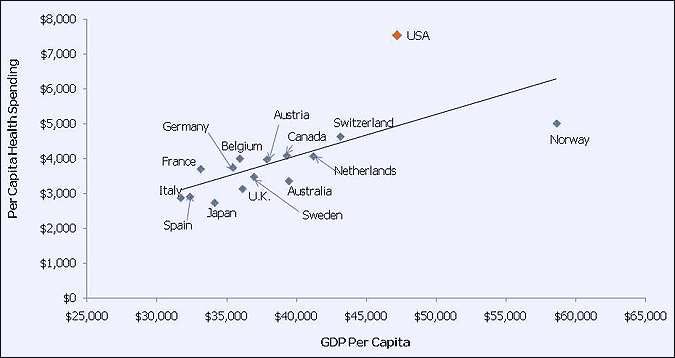
The narrow question is whether the US spends "too much" on healthcare. A counterargument has always been, what else should we spend money on? As a society gets wealthier, it's natural to spend more on health care, just as we spend more on art, travel, and so forth.

(The counterargument to that is, whether we spend more or less is beside the point. The point is a dysfunctional regulated oligopoly is charging way too much for what we get. It's not so bad to spend this much, it's bad to get such a bad deal.)

So, the question is not whether the US spends more on health care, the question is whether we spend more on health care relative to a measure of our standard of wealth.  Using GDP as a rough proxy, we spend a lot more on health care relative to GDP than other countries.

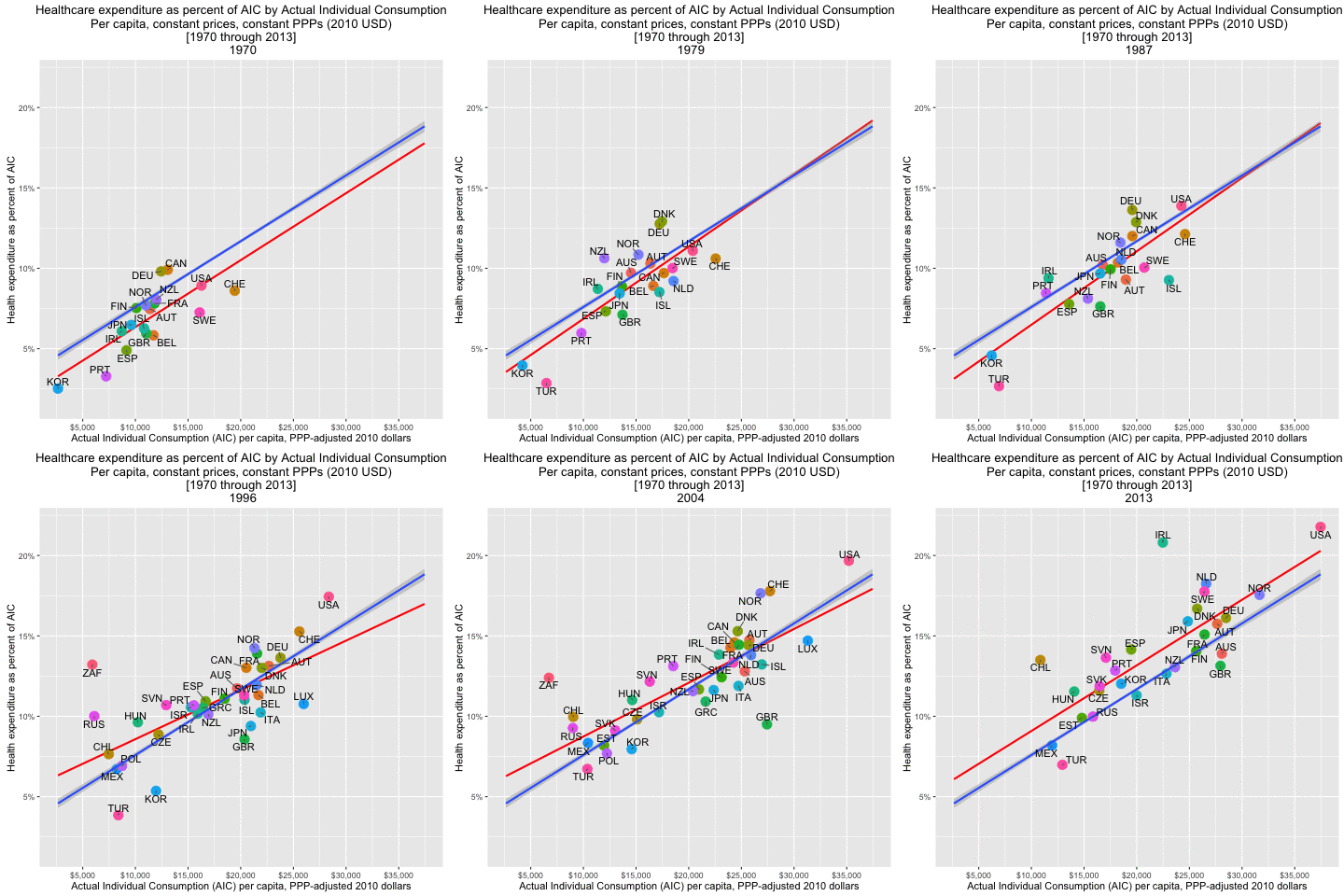
But, the larger point of the blog post, on which I'll focus -- consumption is not GDP (income). Americans are far better off relative to other countries than we think we are. See the graph:

The actual standard of living -- consumption -- is higher in the US than in any of these other countries. Many of them have higher GDP. What's going on? Well, Ireland, for example, hosts a lot of international companies. These chalk up a lot of GDP in Ireland -- a lot seems to be "produced" in Ireland -- but much of it does not go to Irish people. Similarly Switzerland and Luxembourg.

Much of the difference shouldn't last forever of course. How does the US consume more than we produce (GDP)? We borrow from abroad, and run trade deficits. Eventually that lending must be paid back. (Or at least those lending it to us hope so. We'll see.)  Norway is the opposite. They produce a lot of oil, but use the results to save abroad in their sovereign wealth fund, which eventually they can draw on to finance consumption. (Or so they hope, also.) 

In the meantime, though, the difference between income and consumption is quite large. 

This difference is even more important in the cross-section. Income variation is often transitory -- you might have a bad year -- and consumption lasts longer.  People in bad years draw down savings, borrow, or get help from relatives. Most of all, super-rich people save a lot. So inequality of consumption -- of actual standard of living -- is much smaller than inequality of one-year income or wealth. 

RCA anticipates your first objection
this consumption measure includes government transfers, subsidies, etc, notably including the vast majority of healthcare and education spending, as Actual Individual Consumption (AIC) does.
Since some people earlier seemed to miss to this point, I’ll repeat: the only form of consumption excluded from AIC is that which cannot be attributed directly to individuals or households, i.e, collective expenditures by government like military procurement and the like.
I.e. the one thing that is also much larger in the US. And RCA adds nice confirmation. The average US person lives in twice as much space as the average european. And

To the narrow question, US healthcare expenses look out of line compared to GDP


but not at all relative to consumption. (Note the cool dynamic graph) 
The post has lots more beautiful graphs on consumption and health care expenditures. But the main point -- consumption, not income (and especially not one year's income) is a much better measure of living standards -- is larger, and my point, so I'll stop here. 

Oh, and I still think we're getting a massively raw deal from our inefficient health care system. As is much of europe. 


Read more

Selasa, 21 Februari 2017

Long Run Fed Targets

What should the Fed's long-run interest rate target be? The traditional view is that the glide path should aim at 4% -- 2% real plus 2% inflation.

3%?

One big question being debated right now is whether the "natural'' real rate of interest -- r* or "r-star" in econspeak -- has declined below 2%.

Over the long run, the Fed cannot control the real rate of interest -- that comes from how much people want to save and what opportunities there are for investment, i.e. the marginal product of capital. So, if the real rate of interest is now permanently lower, say 1%, then one might argue that the glide path should aim for 3% long-run interest rate -- 1% real plus 2% inflation target -- not 4%.

Janet Yellen recently came to Stanford and gave a very interesting speech that talked in part about a lower r-star, and seemed to be heading to something like this view. See the picture:

Source: Federal Reserve. 

(She also talked a lot about Taylor Rules, seeming to move much closer to John Taylor's view of how to implement monetary policy. See interesting coverage on John Taylor's blog. On r*, see Measuring the Natural Rate of Interest Redux by Thomas Laubach and John C. Williams for a central paper on r*. Henrike Michaelis and Volker Wieland have an interesting post on r* and Taylor rules, also commenting on Ms. Yellen's speech.)

Of course, cynics will say that it's just the latest excuse not to raise rates. But these are serious arguments which should be considered on their merits.

0%?

Should the glidepath head to 3% interest rates? Maybe not. How about zero?


Long ago, Milton Friedman explained the "optimal quantity of money,'' which is really the optimal interest rate. It is zero. Peramazero in St. Louis Fed President Jim Bullard's colorful terminology. At interest rates above zero, people hold less cash, and spend time and effort collecting bills early, paying them late, and so on. This is all a waste of time. Also, taxes on rate of return are a bad idea. With all rates of return that much lower, the tax distortion is that much lower. With 0% interest rates, and correspondingly lower inflation, infaltion-induced capital gains taxes vanish.

So maybe the glidepath should be to 0% interest rate, not 3%.  If the natural real rate is 1%, then inflation should be -1%.

In this line of thinking, the long-run interest rate is what counts directly. It is not a sum of a natural rate and an inflation target. Variation in the natural rate takes care of itself in variation in inflation.

4% ?

Why not? The primary reason often given is that interest rates at zero cannot go substantially below zero, at least without banning cash and many other gyrations of our monetary and financial system. So, if the interest rate is near zero, the Fed does not have "headroom" to stimulate the economy in a recession. I don't necessarily agree that this is so important, but let's go with it for a moment.

Additionally, conventional Keynesian policy analysts worry about a "deflation spiral," if the Fed can't lower rates. I'm not convinced this is a problem either, as recent experience and new Keynesian models don't spiral, (recent paper here), but again we're here today to flesh out the arguments not to adjudicate them.

(A correspondent points out Sticky Leverage by João Gomes, Urban Jermann and Lukas Schmid, and Optimal long-run inflation with occasionally binding financial constraints by Salem Abo-Zaid as two papers pointing to desirable positive long-term inflation and thus long-term nominal rates to keep away from the zero bound. Both have financing constraints as well.)

Both arguments for "headroom" above zero however seem to imply a direct nominal interest rate target, not inflation plus real rate. If the Fed needs four percentage points of headroom (2% real + 2% inflation) then it needs four percentage points of headroom (1% real + 3% inflation), no?

So, from the optimal quantity vs. zero bound-headroom argument it does not follow obviously that the interest rate target should move up and down with the ``natural rate.''

Permatwo? 

The question is, why is there a direct role for the inflation target? Why is that 2%, and then we add r* the long run real rate, to deduce the nominal rate glide point?

I think the answer is this: prices and wages are felt to be sticky, especially downward. That's the second argument against the Friedman rule: its steady deflation is said to require people to change prices and wages downward. That is said to cause disruption.

OK (maybe), no Friedman-optimal deflation. But why then 2% rather than 0% inflation?

Quality and pi star

One argument there is that inflation is overstated due to quality improvements. 2% is really 0%.

The issue: Suppose the iphone 6 turns in to the iphone 7, and costs $100 more. How much of that is inflation, and how much of that is that the iphone 7 is $100 better? Or maybe $200 better, so we are actually seeing iphone deflation? The Bureau of Labor Statistics makes heroic efforts to adjust for this sort of thing, but the consensus seems to be that inflation is still overstated by something like 1-2%.

Some reading on this: The Boskin Commission Report suggested the CPI is overstated by about 1%, as of 1996. Mark Bils, Do Higher Prices for New Goods Reflect Quality Growth or Inflation? argued that it's a good deal more. Mark measured that sales move quickly to new models, which they would not do if it were a price increase after controlling for quality. But Mark's analysis was limited to consumer durables, where quality has been increasing quickly. Many other CPI categories, especially services, are likely less affected.  Philippe Aghion, Antonin Bergeaud, Timo Boppart,  Pete  Klenow and Huiyu Li's Missing Growth from Creative Destruction suggest there is another 0.5%-1% overall because of goods that just disappear from the CPI. (This post all started with discussion following Pete's presentation of the paper recently.)

This is good news. Nominal GDP growth = real GDP growth + inflation. Nominal GDP growth is relatively well measured. If inflation is 1% overstated, then real growth is 1% understated.

It also means our real interest rates are mismeasured. If 2% inflation is really 0% inflation, then 1% interest rates are really +1% real rates, not -1% real rates.

But back to monetary policy. Suppose that 2% inflation is really 0% inflation due to quality effects. Does that mean we should have a 2% long run inflation rate target?

I don't think so. Again, the motivation for a positive inflation target is that there is some economic damage to having to lower prices. But during quality improvements of new goods, nobody has to lower any prices. They are new goods! No existing good has to have lower prices. In fact, actual sticker prices rise.

There is a deeper point here. Not all inflations are equal. One purpose of the CPI is to compare living standards over time. For that purpose, quality adjustments are really important. Another purpose of the CPI is to determine if people have to undergo whatever the pain is associated with lowering prices. For that purpose, quality adjustments are irrelevant.

(On both prices and wages, we also should remember the huge churn. Lots of prices and wages go up, lots go down. The individual is not the average. Changing the average one or two percentage points doesn't change that many individual prices.)

In sum,  the argument that quality improvements mean 2% inflation is really 0% inflation does not argue that therefore the inflation target should be 2% because otherwise people have to lower prices. They don't. Standard-of-living inflation is not the right measure for costs-of-price-stickiness inflation. In price stickiness logic, the Fed should be looking at a CPI measure with no quality adjustments at all!  (At least in this simplistic analysis. This is an invitation to academic papers. If new and old goods are Dixit-Stiglitz substitutes, what are the costs of price stickiness with quality improvements?)
(Update: my correspondent points to "On Quality Bias and Inflation Targets" by Stephanie Schmitt Grohé and Martín Uribe.)

So the argument for a separate inflation target much above zero seems to be weak to me. We're back to Friedman rule vs. headroom, which argues for a direct nominal interest rate target. Since I'm not much of a fan of headroom, I lean to lower values.

Leaving aside price-stickiness, I'm still sympathetic to a price level target on expectations grounds. If the quality adjusted CPI is the same forever, then we have a CPI standard, the value of a dollar is always constant, and long-run uncertainty decreases. We don't shortern the meter 2% every year. For this purpose, we do want the quality-adjusted CPI, and for this purpose the inflation target is primary. An interest rate target would have to rise and fall with r*.

Real rate variation

r* is the real rate. There really is no reason that the "natural" real rate only varies slowly over time. Interest rates crashed in a month 2008 because real rates crashed -- everyone wanted save, and nobody wanted to invest. The Fed couldn't have kept rates at 6% if it wanted to.

So, the procedures used to measure r*, like those used to measure potential output, are a bit suspect. They amount to taking long moving averages, and assuming that "supply" shocks only act slowly over time. More deeply, typical optimal monetary policy discussions use a Taylor rule

         funds rate = r* + 1.5 ( inflation - target) + 0.5 (output gap)

and recommend active short run deviations from the Taylor rule if there are "supply shocks" i.e. r* shocks. Just how the Fed is supposed to distinguish "supply" from "demand" shocks is less clear in reality than the models, which presume shocks are directly visible. A "secular stagnation" fan might say that the moving averages used to measure r* are instead picking up eternally deficient "demand," like a driver with his foot on the brake complaining of headwinds.

Bottom line

As often in policy, we argue too much about the external causes and not enough about the logic tying causes to policy. r* may or may not have declined. But it does not follow that the glidepath nominal rate should be r* plus 2% inflation target. Maybe the glidepath should be 0% nominal rate or 4% nominal rate independent of r*.  You see lots of mechanisms and tradeoffs worthy of modeling.

Read more

Senin, 20 Februari 2017

Miserable 21st Century

Nicholas Eberstadt in Commentary, (HT Marginal Revolution) offers a revealing look at what's wrong with "middle" America's stagnation. Read the whole thing, but the following snapshot jumped out at me.

He starts with a review, probably familiar to readers of this blog, of the sharp decline in work rates, even among prime-age men and women.
As of late 2016, the adult work rate in America was still at its lowest level in more than 30 years. To put things another way: If our nation’s work rate today were back up to its start-of-the-century highs, well over 10 million more Americans would currently have paying jobs.
Why are so many not working, not studying for work, and not even looking for work? What is going on in their lives? One answer:
The opioid epidemic of pain pills and heroin that has been ravaging and shortening lives from coast to coast is a new plague for our new century...
According to [Alan Krueger's] work, nearly half of all prime working-age male labor-force dropouts—an army now totaling roughly 7 million men—currently take pain medication on a daily basis.
I think Krueger had a different idea in mind: that they are in pain, indicated by medication, so can't be expected to work. How the explosion in disability jibes with a much safer workplace is an interesting puzzle to that view. Eberstadt has a different interpretation, and the lovely thing about facts is they are facts, not interpretations.
We already knew from other sources (such as BLS “time use” surveys) that the overwhelming majority of the prime-age men in this un-working army generally don’t “do civil society” (charitable work, religious activities, volunteering), or for that matter much in the way of child care or help for others in the home either, despite the abundance of time on their hands. Their routine, instead, typically centers on watching—watching TV, DVDs, Internet, hand-held devices, etc.—and indeed watching for an average of 2,000 hours a year, as if it were a full-time job. But Krueger’s study adds a poignant and immensely sad detail to this portrait of daily life in 21st-century America: In our mind’s eye we can now picture many millions of un-working men in the prime of life, out of work and not looking for jobs, sitting in front of screens—stoned.
(Mark Aguiar, Mark Bils, and Kewin Charles and Erik Hurst have a new paper coming soon, which I just saw presented, "Leisure Luxuries and the Labor Supply of Young Men", with some more facts about time-allocation of non-working young men. They emphasize cheaper and better video games and leave out drugs.)
But how did so many millions of un-working men, whose incomes are limited, manage en masse to afford a constant supply of pain medication? Oxycontin is not cheap. As Dreamland carefully explains, one main mechanism today has been the welfare state: more specifically, Medicaid, Uncle Sam’s means-tested health-benefits program. Here is how it works (we are with Quinones in Portsmouth, Ohio):
"[The Medicaid card] pays for medicine—whatever pills a doctor deems that the insured patient needs. Among those who receive Medicaid cards are people on state welfare or on a federal disability program known as SSI. . . . If you could get a prescription from a willing doctor—and Portsmouth had plenty of them—Medicaid health-insurance cards paid for that prescription every month. For a three-dollar Medicaid co-pay, therefore, addicts got pills priced at thousands of dollars, with the difference paid for by U.S. and state taxpayers. A user could turn around and sell those pills, obtained for that three-dollar co-pay, for as much as ten thousand dollars on the street."
You may now wish to ask: What share of prime-working-age men these days are enrolled in Medicaid? According to the Census Bureau’s SIPP survey (Survey of Income and Program Participation), as of 2013, over one-fifth (21 percent) of all civilian men between 25 and 55 years of age were Medicaid beneficiaries. For prime-age people not in the labor force, the share was over half (53 percent). And for un-working Anglos (non-Hispanic white men not in the labor force) of prime working age, the share enrolled in Medicaid was 48 percent.
By the way: Of the entire un-working prime-age male Anglo population in 2013, nearly three-fifths (57 percent) were reportedly collecting disability benefits from one or more government disability program in 2013. Disability checks and means-tested benefits cannot support a lavish lifestyle. But they can offer a permanent alternative to paid employment, and for growing numbers of American men, they do. The rise of these programs has coincided with the death of work for larger and larger numbers of American men not yet of retirement age. We cannot say that these programs caused the death of work for millions upon millions of younger men: What is incontrovertible, however, is that they have financed it—just as Medicaid inadvertently helped finance America’s immense and increasing appetite for opioids in our new century.
The VA has also been a part of getting veterans addicted to pain killers.

If you dozed off, the main point: Half of non-working prime age men take daily pain medication. Half of non-working prime-age people are in Medicaid, which pays for re-sellable opiates. Three-fifths of non-working prime age Anglos receive disability payments. The latter benefits disappear if you take a job, or if you move, a steep disincentive that Nick does not mention.

I knew the story, but was not really clear on the magnitude. Half.

An advantage of government-subsidized drugs Nick points out: crime is down. However, our criminal justice system offers another barrier to employment and advancement:
...rough arithmetic suggests that about 17 million men in our general population have a felony conviction somewhere in their CV. That works out to one of every eight adult males in America today.
In the understatement of the year,
we might guess that their odds in the real America are not all that favorable.
The bottom line
And when we consider some of the other trends we have already mentioned—employment, health, addiction, welfare dependence—we can see the emergence of a malign new nationwide undertow, pulling downward against social mobility.
Actually looking at people's lives in this way is devastating to the nostrum that "inequality" is mysteriously increasing and just needs more transfers, or its just a lack of "jobs" which can be brought back by left-wing "demand" or right-wing trade restrictions.
people inside the bubble are forever talking about “economic inequality,” that wonderful seminar construct, and forever virtue-signaling about how personally opposed they are to it. By contrast, “economic insecurity” is akin to a phrase from an unknown language.
This is I think an inartful choice of language. I hear "insecurity" a lot from the left, for example just how it is that obese people have trouble paying for food. And, Orwellian language or not, they do have a point. "Insecurity" is not the core of the problem. "Barriers to Advancement" sounds too old fashioned. "Caught in the web of awful disincentives" is more accurate but does not sing.
The abstraction of “inequality” doesn’t matter a lot to ordinary Americans. ...The Great American Escalator is broken—and it badly needs to be fixed.
With the election of 2016, Americans within the bubble finally learned that the 21st century has gotten off to a very bad start in America.
Reading the Weekend New York Times, especially the Review, I think this is actually false. Americans within the bubble are still foaming at the mouth with Trump Derangement Syndrome. But when they get a grip,
Welcome to the reality. We have a lot of work to do together to turn this around.
Read more

Senin, 13 Februari 2017

Economies in reverse

How can economies forget? How is it that once we have learned to do something better, that knowledge can be lost and economies move backward? How can productivity decline? Viewing productivity as knowledge, it would seem almost impossible for it to do so -- and real business cycle theory was often derided on that point. Yet middle ages eurpoeans lost the recipe for concrete, and time after time we have seen economies get worse. How can our own productivity be growing so slowly overall when so much we see around us is progressing so fast?

Scott Alexander at Slate Star Codex has an intriguing blog post that illuminates these questions (HT marginal revolution). I'll offer my thoughts on the answers at the end.

Scott starts with education:

Inputs triple, output unchanged. Productivity dropped to a third of its previous level.


Scott offers remarkable economic clarity on the issue:
"Which would you prefer? Sending your child to a 2016 school? Or sending your child to a 1975 school, and getting a check for $5,000 every year?

I’m proposing that choice because as far as I can tell that is the stakes here. 2016 schools have whatever tiny test score advantage they have over 1975 schools, and cost $5000/year more, inflation adjusted. That $5000 comes out of the pocket of somebody – either taxpayers, or other people who could be helped by government programs.
...College is even worse. Inflation-adjusted cost of a university education was something like $2000/year in 1980. Now it’s closer to $20,000/year.... Do you think that modern colleges provide $18,000/year greater value than colleges did in your parents’ day? Would you rather graduate from a modern college, or graduate from a college more like the one your parents went to, plus get a check for $72,000?  (or, more realistically, have $72,000 less in student loans to pay off)"
Health care is similarly bloated, though a more complex case.
The cost of health care has about quintupled since 1970. ... The average 1960 worker spent ten days’ worth of their yearly paycheck on health insurance; the average modern worker spends sixty days’ worth of it, a sixth of their entire earnings. 
Unlike schooling, health care is unquestionably better now. Scott notices that lifespan doesn't go up as much as we might have hoped, and other countries get the same lifespan with much less cost. Tell that to someone with an advanced cancer, curable with modern drugs and not with 1970 drugs. Still, it's a good example to keep in mind, as it's pretty clear health care is delivering a technologically more advanced product with a huge decrease in organizational efficiency.

Infrastructure, today's cause célèbre is more telling,
"The first New York City subway opened around 1900. ...That looks like it’s about the inflation-adjusted equivalent of $100 million/kilometer today... In contrast, Vox notes [JC: This is an excellent article worth a blog post on its own] that a new New York subway line being opened this year costs about $2.2 billion per kilometer, suggesting a cost increase of twenty times – although I’m very uncertain about this estimate.
...The same Vox article notes that Paris, Berlin, and Copenhagen subways cost about $250 million per kilometer, almost 90% less. Yet even those European subways are overpriced compared to Korea, where a kilometer of subway in Seoul costs $40 million/km (another Korean subway project cost $80 million/km). This is a difference of 50x between Seoul and New York for apparently comparable services. It suggests that the 1900s New York estimate above may have been roughly accurate if their efficiency was roughly in line with that of modern Europe and Korea."
I have seen similar numbers for high speed trains -- ours cost multiples of France's, let alone China's.

I find this one particularly telling, because we're building 19th century technology, with 21st century tools -- huge boring machines that dramatically cut costs. And other countries still know how to do it for costs orders of magnitude lower than ours.

Similarly, housing. bottom line
"Or, once again, just ask yourself: do you think most poor and middle class people would rather:

1. Rent a modern house/apartment

2. Rent the sort of house/apartment their parents had, for half the cost"
Housing is a little different I think, because much of the cost rise is the value of land, so supply restrictions are clearly at work.

More useful anectdotes, on whether this is real or just a figment of statistics.
The last time I talked about this problem, someone mentioned they’re running a private school which does just as well as public schools but costs only $3000/student/year, a fourth of the usual rate. Marginal Revolution notes that India has a private health system that delivers the same quality of care as its public system for a quarter of the cost. Whenever the same drug is provided by the official US health system and some kind of grey market supplement sort of thing, the grey market supplement costs between a fifth and a tenth as much; for example, Google’s first hit for Deplin®, official prescription L-methylfolate, costs $175 for a month’s supply; unregulated L-methylfolate supplement delivers the same dose for about $30. And this isn’t even mentioning things like the $1 bag of saline that costs $700 at hospitals. 
Where is the money going? It's not, despite what you may think, going to higher salaries:


Scott has similar evidence for college professors, doctors, nurses and so on. What about fancy salaries you hear about?
...colleges are doing everything they can to switch from tenured professors to adjuncts, who complain of being overworked and abused while making about the same amount as a Starbucks barista.
It's also not going to profits, or CEO salaries. Those have not risen by the orders of magnitude necessary to explain the cost disease.
This can’t be pure price-gouging, since corporate profits haven’t increased nearly enough to be where all the money is going.
My thoughts below.

Scott's elegant summary:
So, to summarize: in the past fifty years, education costs have doubled, college costs have dectupled, health insurance costs have dectupled, subway costs have at least dectupled, and housing costs have increased by about fifty percent. US health care costs about four times as much as equivalent health care in other First World countries; US subways cost about eight times as much as equivalent subways in other First World countries.

And this is especially strange because we expect that improving technology and globalization ought to cut costs. In 1983, the first mobile phone cost $4,000 – about $10,000 in today’s dollars. It was also a gigantic piece of crap. Today you can get a much better phone for $100. This is the right and proper way of the universe. It’s why we fund scientists, and pay businesspeople the big bucks.

But things like college and health care have still had their prices dectuple. Patients can now schedule their appointments online; doctors can send prescriptions through the fax, pharmacies can keep track of medication histories on centralized computer systems that interface with the cloud, nurses get automatic reminders when they’re giving two drugs with a potential interaction, insurance companies accept payment through credit cards – and all of this costs ten times as much as it did in the days of punch cards and secretaries who did calculations by hand.

It’s actually even worse than this, because we take so many opportunities to save money that were unavailable in past generations. Underpaid foreign nurses immigrate to America and work for a song. Doctors’ notes are sent to India overnight where they’re transcribed by sweatshop-style labor for pennies an hour. Medical equipment gets manufactured in goodness-only-knows which obscure Third World country. And it still costs ten times as much as when this was all made in the USA – and that back when minimum wages were proportionally higher than today.

And it’s actually even worse than this. A lot of these services have decreased in quality, presumably as an attempt to cut costs even further. Doctors used to make house calls; even when I was young in the ’80s my father would still go to the houses of difficult patients who were too sick to come to his office. This study notes that for women who give birth in the hospital, “the standard length of stay was 8 to 14 days in the 1950s but declined to less than 2 days in the mid-1990s”. The doctors I talk to say this isn’t because modern women are healthier, it’s because they kick them out as soon as it’s safe to free up beds for the next person. Historic records of hospital care generally describe leisurely convalescence periods and making sure somebody felt absolutely well before letting them go; this seems bizarre to anyone who has participated in a modern hospital, where the mantra is to kick people out as soon as they’re “stable” ie not in acute crisis.

If we had to provide the same quality of service as we did in 1960, and without the gains from modern technology and globalization, who even knows how many times more health care would cost? Fifty times more? A hundred times more?
And the same is true for colleges and houses and subways and so on.
Scott points out that many of our intractable political debates -- paying for college, health care, housing, and transportation, are made intractable by this bloat:
 I don’t know why more people don’t just come out and say “LOOK, REALLY OUR MAIN PROBLEM IS THAT ALL THE MOST IMPORTANT THINGS COST TEN TIMES AS MUCH AS THEY USED TO FOR NO REASON, PLUS THEY SEEM TO BE GOING DOWN IN QUALITY, AND NOBODY KNOWS WHY, AND WE’RE MOSTLY JUST DESPERATELY FLAILING AROUND LOOKING FOR SOLUTIONS HERE.” State that clearly, and a lot of political debates take on a different light.
What's happening?

I think Scott's post is exceptionally good because it points out the enormous size of the problem. It's just not salient to point to productivity numbers that grow a few percentage points higher or lower. When you add it up over decades to see that while some things have gotten ten times better, other things are ten times more expensive than they should be really strikes home.

Scott tries on a list of candidate explanations and doesn't really find any. He comes closest with regulation, but correctly points out that formal regulatory requirements, though getting a lot worse, don't add up to the huge size of this cost disease.

So, what is really happening? I think Scott nearly gets there. Things cost 10 times as much, 10 times more than they used to and 10 times more than in other countries. It's not going to wages. It's not going to profits. So where is it going?

The unavoidable answer: The number of people it takes to produce these goods is skyrocketing. Labor productivity -- quality adjusted output per number of people involved in the entire process -- declined by a factor of 10 in these areas. It pretty much has to be that: if the money is not going to profits, to to each employee, it must be going to the number of employees.

How can that happen? Our machines are better than ever, as Scott points out. Well, we (and especially we economists) pay too much attention to snazzy gadgets. Productivity depends on organizations not just on gadgets. Southwest figured out how to turn an airplane around in 20 minutes, and it still takes United an hour.

Contrariwise, I think we know where the extra people are. The ratio of teachers to students hasn't gone down a lot -- but the ratio of administrators to students has shot up. Most large public school systems spend more than half their budget on administrators. Similarly, class sizes at most colleges and universities haven't changed that much -- but administrative staff have exploded. There are 2.5 people handling insurance claims for every doctor. Construction sites have always had a lot of people standing around for every one actually working the machine. But now for every person operating the machine there is an army of planners, regulators, lawyers, administrative staff, consultants and so on. (I welcome pointers to good graphs and numbers on this sort of thing.)

So, my bottom line: administrative bloat.

Well, how does bloat come about? Regulations and law are, as Scott mentions, part of the problem. These are all areas either run by the government or with large government involvement. But the real key is, I think lack of competition. These are above all areas with not much competition. In turn, however, they are not by a long shot "natural monopolies" or failure of some free market. The main effect of our regulatory and legal system is not so much to directly raise costs, as it is to lessen competition (that is often its purpose). The lack of competition leads to the cost disease.

Though textbooks teach that monopoly leads to profits, it doesn't "The best of all monopoly profits is a quiet life" said Hicks.  Everywhere we see businesses protected from competition, especially highly regulated businesses, we see the cost disease spreading. And it spreads largely by forcing companies to hire loads of useless people.

Yes, technical regress can happen. Productivity depends as much on the functioning of large organizations, and the overall legal and regulatory system in which they operate, as it does on gadgets. We can indeed "forget" how those work. Like our ancestors peer at the buildings, aqueducts, dams, roads, and bridges put up by our ancestors, whether Roman or American, and wonder just how they did it.


Read more

Selasa, 24 Januari 2017

Uncommon Knowledge Interview


A broad-ranging interview on economics and policy by Peter Robinson as part of the Hoover "Uncommmon Knowledge" series. Click above for youtube, or

· Hoover Institution: http://www.hoover.org/research/whats-wrong-american-economy

· Twitter: https://twitter.com/uncknowledge/status/823926553058775042

· Facebook: https://www.facebook.com/UncKnowledge/

· Instagram: https://www.instagram.com/p/BPF8TnJgsBz/?taken-by=uncommon_knowledge_show

· Youtube: https://www.youtube.com/watch?v=spe619WX-Q4

· Bitly Link: http://hvr.co/2jqxNkp

The full transcript is available on the episode page at http://www.hoover.org/research/whats-wrong-american-economy.
Read more